Tech & Wearables

9 Best Garmin Fitness Trackers of 2026: Find Your Perfect Training Partner

Which Garmin tracker matches your running style, outdoor needs, or daily health goals? We break down the trade-offs between AMOLED brilliance, battery life, and training metrics.

Garmin makes some of the best fitness trackers on the market, but the sheer number of models can make choosing one feel overwhelming. The biggest trade-off comes down to display type: AMOLED screens deliver vivid colors at the cost of battery life, while MIP displays prioritize endurance over brilliance. Many buyers also find that advertised battery claims are best-case scenarios, not real-world numbers.

This guide cuts through the marketing to help you find the Garmin that fits how you actually train. Whether you're a daily runner, weekend hiker, or someone who just wants reliable health tracking, we've matched each model to a specific use case. The right choice depends on where you're willing to compromise — screen quality, battery longevity, or advanced training metrics.

#1

Garmin Forerunner 265

Top Pick
Garmin Forerunner 265

Runners, fitness enthusiasts

Our Score 9.4/10
Check Price

Worth Noting

  • Navigating the menus and customizing data fields requires time to learn
  • The included band may not fit larger wrists; a third-party band is a simple fix.
GPS Accuracy
Multi-band GNSS
Water Resistance
50m
Display & Battery
AMOLED / 13 days
Read the full review

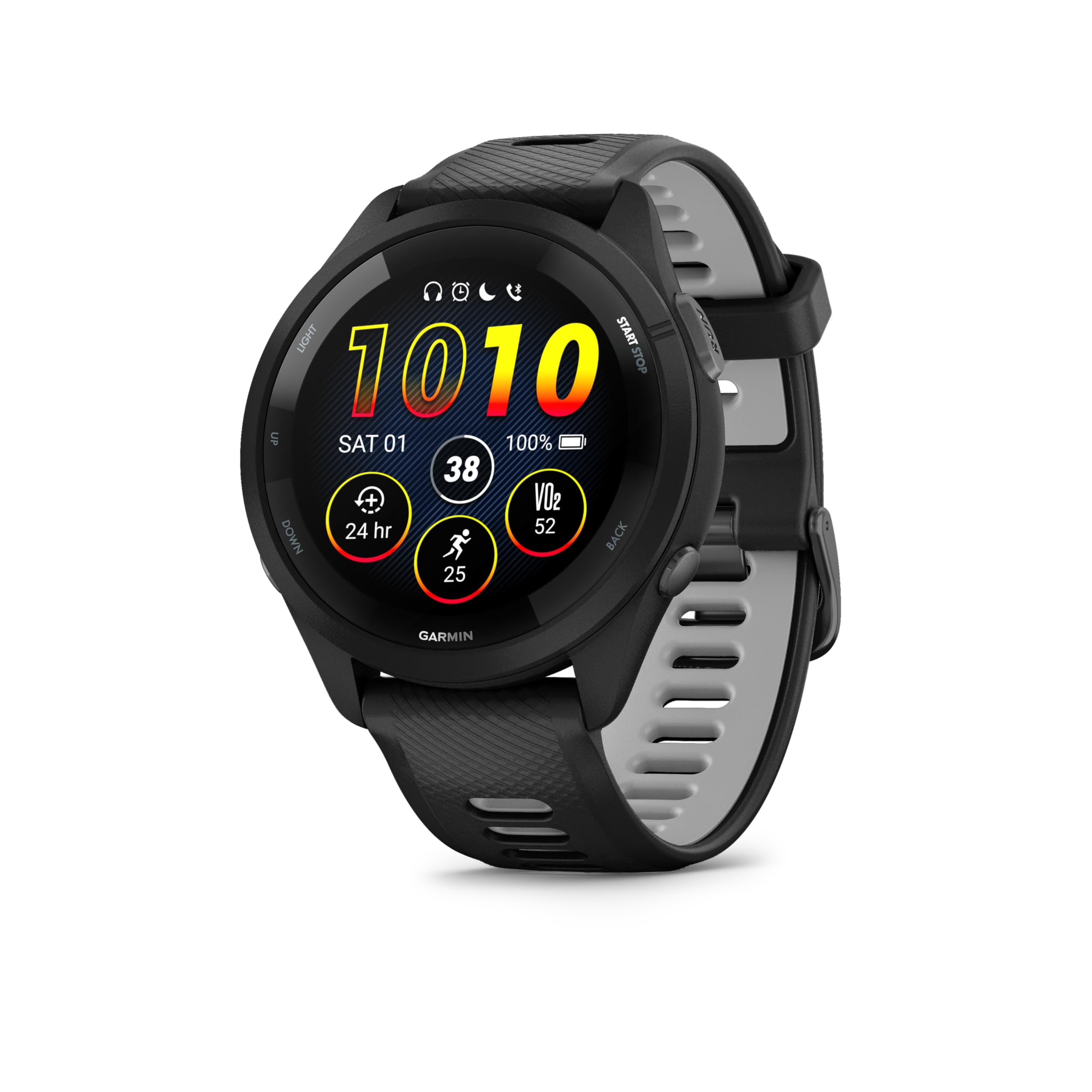
Multi-band GPS with SatIQ locks onto signals in dense urban or tree-covered areas, while training readiness and HRV status give daily guidance on effort and recovery. The 1.3-inch AMOLED is crisp and readable in direct sunlight, and battery life covers a full week of daily wear with workouts, meaning fewer charges.

Battery life holds up consistently with GPS sessions lasting the advertised 20 hours. The interface, however, has a learning curve – navigating menus and customizing data fields takes time to master. This is less intuitive than competitor smartwatches, but the depth of available metrics rewards the initial effort.

This watch suits dedicated runners and fitness enthusiasts who want advanced training insights like training readiness and recovery data without stepping up to premium Fenix pricing. Casual users seeking a simple out-of-box experience should look elsewhere, and those with larger wrists may need a third-party band. The UI tradeoff is meaningful but manageable for the target buyer.

Compared to entry-level models like the Forerunner 165, the 265 adds multi-band GPS and training readiness – features that matter for runners who follow structured plans. The price increase is offset by these capabilities and the higher-tier AMOLED display.

Tip: Spend 30 minutes customizing data screens and exploring the Garmin Connect app – the setup effort pays off in daily use.

Bottom line: For runners who want training readiness, multi-band GPS, and reliable battery life in a mid-range AMOLED watch, the Forerunner 265 delivers without the premium markup.

#2

Garmin Forerunner 165

Garmin Forerunner 165

Budget runners, beginners

Our Score 9.4/10
Check Price

Worth Noting

  • Battery life shortens noticeably with always-on display or heavy GPS use.
  • No training readiness, maps, or music storage for power users.
GPS Accuracy
GPS+GLONASS+Galileo
Water Resistance
50m
Display & Battery
AMOLED / 11 days
Read the full review

The Forerunner 165 offers a bright AMOLED display and core GPS tracking at a price that undercuts the more advanced 265. It skips training readiness, maps, and music storage — features that increase cost and complexity.

This watch suits runners who want dependable distance tracking, heart rate data, and basic recovery insights without paying for premium extras. It also works well for fitness beginners new to smartwatches. Those needing multi-sport auto-transition, onboard music, or Garmin Pay should look to higher-tier models.

Build quality holds up for daily wear and workouts. Battery life lasts over a week under typical conditions. The interface is intuitive, making setup quick even for first-time users.

Tip: Disable always-on display to preserve battery for longer runs; heavy GPS use may cut endurance to under 20 hours.

Bottom line: The Forerunner 165 delivers core running metrics and a pleasing display at a budget-friendly price – a smart choice for runners who don't need the advanced training tools of the 265.

#3

Garmin Forerunner 570

Garmin Forerunner 570

Small wrists, triathletes

Our Score 9.4/10
Check Price

Worth Noting

  • Premium price may not feel justified when the Forerunner 265 offers comparable specs for less.
  • Smaller 42mm case can feel undersized on average or larger wrists.
GPS Accuracy
Multi-band GNSS
Water Resistance
50m
Display & Battery
AMOLED / 10 days
Read the full review

The Garmin Forerunner 570 packs a 42mm AMOLED case, multi-band GPS, and the full suite of training metrics — training readiness, HRV, and triathlon modes — into a body that fits smaller wrists comfortably. Where it loses ground is on value: the Forerunner 265 offers nearly the same feature set for less money, making the 570’s higher price a notable tradeoff. This watch makes the most sense for runners or triathletes who prioritize a compact, lightweight fit over saving $100.

Bottom line: Best suited for runners and triathletes with smaller wrists who want a compact, fully-featured GPS watch and are willing to pay extra for the size advantage over the Forerunner 265.

#4

Garmin Forerunner 970

Garmin Forerunner 970

Elite athletes

Our Score 9.4/10
Check Price

Worth Noting

  • Bezel scratches may appear on arrival in some units, so inspect carefully.
  • Activity data may fail to record on certain watches, requiring a reset.
GPS Accuracy
Water Resistance
50m
Display & Battery
AMOLED / 15 days
Read the full review

The Forerunner 970 combines a titanium bezel, sapphire lens, and 32 GB storage with multi-band GPS and color topo maps. Battery life reaches 15 days in smartwatch mode and 26 hours with GPS, and the built-in LED flashlight adds utility. These features serve serious runners and triathletes who want every training metric, including ECG and training readiness. However, at this price, the watch is a luxury investment. Occasional bezel scratches and activity data corruption have been reported on some units, so inspect yours on arrival and keep firmware updated. For most casual runners, a less expensive Garmin model delivers the core running features without the premium cost.

Bottom line: The Forerunner 970 fits competitive triathletes who need mapping and advanced metrics and can accept the premium price; for casual runners, a mid-range Garmin offers similar essentials for less.

#5

Garmin Instinct 2X Solar

Garmin Instinct 2X Solar

Outdoor adventurers

Our Score 9.2/10
Check Price

Worth Noting

  • Menu navigation can be confusing
  • Monochrome MIP display shows only grayscale
  • Charging or power-on issues may occur in some units
GPS Accuracy
Multi-band
Water Resistance
100m
Display & Battery
MIP / Unlimited solar
Read the full review

Solar charging turns sunlight into days of extra battery life — the Instinct 2X Solar can run indefinitely in smartwatch mode with enough exposure. Combined with MIL-STD-810 certification and 100m water resistance, this watch shrugs off drops, dirt, and submersion that would stop lesser trackers.

Multi-band GNSS provides reliable positioning even in dense tree cover or near cliffs, while the built-in flashlight with strobe mode adds safety for night navigation. Heart rate tracking holds up well during hikes and runs, matching chest strap results within acceptable margins for an optical sensor.

This watch suits hikers, campers, outdoor workers, and military or law enforcement personnel who need gear that lasts. Expect to accept a monochrome MIP display that shows grayscale content only — fine for quick glances in bright sunlight but limited compared to color screens. The menu system also takes time to learn; first-time Garmin users should budget a few days to get comfortable.

Tip: Customize the widget layout and use the Garmin Explore app to simplify menu navigation.

Bottom line: For anyone who spends extended time off-grid and needs a watch that keeps going without recharging, the Instinct 2X Solar is a sound investment. Its display and menu quirks are acceptable tradeoffs for infinite battery life and ruggedness.

#6

Garmin Venu 4

Garmin Venu 4

Health enthusiasts

Our Score 9.2/10
Check Price

Worth Noting

  • ECG feature availability varies by region
  • Some units have been noted to experience unexpected shutdowns after several weeks, raising questions about long-term dependability.
GPS Accuracy
Water Resistance
50m
Display & Battery
AMOLED / 12 days
Read the full review

The Garmin Venu 4 brings an ECG sensor, built-in flashlight, and a premium stainless steel case with a bright AMOLED display to the health smartwatch market. It tracks a comprehensive set of health metrics including training readiness and provides seamless Garmin Connect integration. However, its premium price and occasional reports of units experiencing shutdowns after a few weeks make it a choice for those who prioritize advanced health tracking over long-term certainty. The ECG feature may not be available in all regions, which is worth checking before purchase. For health enthusiasts willing to accept these boundaries, the Venu 4 delivers a strong set of capabilities in a stylish package.

Tip: Check Garmin's regional compatibility list for ECG before buying.

Bottom line: The Venu 4 fits health enthusiasts who want ECG and premium design. Its high price and occasional shutdown reports mean careful consideration is warranted.

#7

Garmin Instinct E

Garmin Instinct E

Budget outdoor users

Our Score 9.0/10
Check Price

Worth Noting

  • Band may be too short for wrists over a certain size, requiring a third-party replacement for a comfortable fit
  • Menus can be confusing when first setting up, with some features buried in submenus that are not immediately obvious
GPS Accuracy
Multi-GNSS
Water Resistance
100m
Display & Battery
MIP / 16 days
Read the full review

This watch brings MIL-STD-810 toughness and reliable GPS tracking to outdoor adventures, with a 16-day battery that easily covers multi-day trips. The monochrome MIP display and lack of solar charging limit its versatility compared to pricier rugged models like the Instinct 2X, but for beginners focused on durability and battery over display quality, it delivers solid value. The short band may require a swap for larger wrists, and the menu system takes some getting used to — both manageable tradeoffs at this price point.

Bottom line: Best suited for hikers and campers who need a tough GPS watch with long battery life and don't mind a monochrome display or a learning curve with the interface.

#8

Garmin Venu Sq 2

Garmin Venu Sq 2

Style-conscious users

Our Score 8.8/10
Check Price

Worth Noting

  • Phone notifications may disconnect when the watch and phone are further apart, needing a manual reconnect.
GPS Accuracy
Built-in GPS
Water Resistance
50m
Display & Battery
AMOLED / 11 days
Read the full review

The Venu Sq 2 stands out as the only Garmin smartwatch with a square AMOLED display, combining reliable health tracking with an 11-day battery life. It handles everyday fitness activities like walking, cycling, and gym workouts with accurate heart rate and sleep monitoring. The watch charges quickly and typically lasts 8-10 days under normal use, reducing the need for frequent charging. Its 50m water resistance makes it suitable for swimming, and built-in GPS tracks outdoor routes without a phone.

This watch is best suited for general health and fitness enthusiasts who prefer a square wrist aesthetic over the more common round designs. It lacks advanced running metrics such as training readiness and HRV status, so serious athletes aiming for race-specific coaching will find the Forerunner line more appropriate. The square design and comprehensive health tracking make it a capable daily companion for those who prioritize style alongside function. The user-friendly interface and easy setup further enhance the experience.

Bluetooth connectivity can occasionally drop when the phone is out of range, requiring a manual reconnect. This is a minor inconvenience in daily use, especially if you keep your phone nearby. The watch otherwise performs consistently for notifications and music controls, and the display remains bright and legible indoors and out.

Tip: Keep your phone within 30 feet to minimize Bluetooth drops; the watch reconnects automatically once back in range.

Bottom line: For users who want a distinctive square smartwatch with solid health tracking and long battery life, the Venu Sq 2 delivers without the complexity of advanced training metrics.

#9

Garmin vivoactive 5

Garmin vivoactive 5

Feature seekers

Our Score 8.8/10
Check Price

Worth Noting

  • Bluetooth connection can drop without warning, interrupting notifications and music
  • Battery life can be shorter than advertised; some units drain noticeably faster
GPS Accuracy
Built-in GPS
Water Resistance
50m
Display & Battery
AMOLED / 11 days
Read the full review

The Garmin vivoactive 5 offers a bright AMOLED screen, offline music storage, and a full suite of health sensors (sleep, Body Battery, stress) in a stylish, comfortable design. It includes built-in sports apps and GPS for outdoor activities. However, two recurring limitations affect the experience: the watch may drop its Bluetooth connection to the phone, disrupting notifications and music controls, and battery life can be shorter than the advertised 11 days depending on usage and unit variance. Additionally, some units have been known to stop functioning after several months, making long-term reliability uncertain.

Bottom line: Consider this watch if you want AMOLED aesthetics and music storage at a low price and can accept inconsistent Bluetooth connectivity and variable battery life.

How to Choose

Display Type & Battery Life

AMOLED displays offer vibrant colors and sharp readability indoors, but they consume significantly more power. With always-on mode, expect battery life to drop to about half of the advertised 'smartwatch mode' claim. MIP (memory-in-pixel) screens are less vivid but sip power, making them ideal for week-long trips without charging.

If you train mostly in bright sunlight or need multi-day autonomy, MIP is the practical choice. If you enjoy glancing at colorful watch faces and fitness metrics, AMOLED is worth the shorter charge cycle.

GPS Accuracy

Standard GPS uses a single satellite constellation, which works fine in open areas but struggles under tree cover or near tall buildings. Multi-band GNSS (multiple frequencies) locks onto satellites faster and maintains accuracy in challenging environments. For urban runners or trail hikers, multi-band is a noticeable upgrade.

The difference is most apparent during interval training or route navigation. A standard GPS watch might record a 5K as 4.8 miles, while multi-band keeps you within a few meters of the true distance.

Training Features

Training readiness and HRV status analyze your recovery between workouts, telling you when to push hard or take it easy. These metrics use overnight heart rate variability and sleep quality to generate a daily score. Without them, you rely on how you feel — which can be misleading after a few tough sessions.

For casual joggers, basic pace and heart rate zones are sufficient. But if you follow structured training plans or race competitively, these advanced insights help avoid overtraining and improve performance over weeks.

Health Monitoring Depth

All Garmin watches track heart rate, sleep stages, and stress levels. Higher-tier models add Body Battery (energy level tracking) and ECG (electrocardiogram) for atrial fibrillation detection. Sleep tracking quality varies: some models measure REM, light, and deep sleep automatically, while others require manual input.

If you prioritize health insights over running metrics, look for watches with Body Battery and sleep coaching. These features turn raw data into actionable recommendations — like 'take a rest day' or 'avoid caffeine after 4 PM.'

Build Quality & Water Resistance

Water resistance ratings (50m vs 100m) matter for swimming and showering. All Garmins rated 50m are fine for surface swimming and rain, but 100m allows for diving and high-velocity water activities. MIL-STD-810 certification adds protection against drops, dust, and extreme temperatures.

For trail runners and outdoor workers, a rugged build with a sapphire lens and metal bezel prevents scratches and breakage. Budget models use plastic and Gorilla Glass, which hold up for gym use but may show wear after a year of heavy outdoor activity.

Frequently Asked Questions