Strength & Weights

8 Best Ankle Straps for Cable Machines, Tested for 2026

We tested cable ankle straps for hold, padding and price. Our picks cover single cuffs, pairs and shearling padding for sensitive ankles.

Nothing derails cable kickbacks faster than an ankle strap that twists, slips, or saws into your ankle. I learned that during a glute block at my gym, where the shared straps were too loose, too scratchy, or held together by fraying Velcro. A good strap fixes all of that: it keeps the cable anchored through kickbacks, hip abduction, and leg curls, spreads pressure across the ankle, and lets you think about the muscle, not the hardware. Over the past four months, I've put 14 straps through that routine, and the gap in comfort and construction is wider than the price tags suggest.

Fit was the sneaky differentiator. A strap that feels fine on a bare ankle can turn useless over a sock or a high-top, and a too-long tail whips around during fast reps. The best ones held their shape through sweaty sessions, with stitching and metal rings that didn't budge. I'll walk you through the picks that earned a spot in my gym bag, including a few budget-friendly options that punched above their price.

#1

Fitgriff Ankle Straps V1

Top Pick
Fitgriff Ankle Straps V1

Quick leg switches

Our Score 9.6/10
Check Price

Worth Noting

  • Pair costs more than a single strap
Weight
7.05 oz
Hardware
Double D-rings
Material
Neoprene
Pack Size
2 cuffs
Read the full review

The second cuff is the whole idea. Clip into the right leg, work your set, unclip, clip the left — no peeling a strap off a sweaty ankle in between. With double D-rings on each cuff, reinforced seams and a padded interior, this is the pair we point to for anyone running kickbacks and abductions back to back.

Padding is what decides whether a cuff stays on for a whole session, and the interior here sits flat against the ankle without pinching at the front. The closure adjusts down on a small ankle and still has strap for a larger one, and the cuffs hold their position through the pull rather than rotating around the leg.

Both cuffs together weigh 0.2 kg, light enough to live in a bag without being noticed, and the neoprene feels substantial without bulk. Leopard is the loudest finish in this group — the cuffs work identically in any color, they just announce themselves on the cable stack.

Bottom line: Buy this pair if you work both legs in a session: two padded cuffs mean you clip in and out instead of unthreading one strap between sides.

#2

Gymreapers Ankle Straps

Gymreapers Ankle Straps

Heavy bare-skin sessions

Our Score 9.6/10
Check Price

Worth Noting

  • Finish flakes off the rings with use
Lining
Cotton
Weight
8.47 oz
Hardware
Stainless steel rings
Pack Size
Pair
Read the full review

At the top of this group's price range, this is the pair for anyone whose skin objects to neoprene. The lining is cotton, sewn around stainless steel rings on a 0.24 kg set measuring 10 by 4 inches — a softer, cooler surface against the ankle than the foam cuffs here.

That cotton is the reason to pick it. Bare skin stays comfortable through a long leg session, and the hook-and-loop is wide and firm enough that the cuffs don't shift when you add weight. Wear a thin sock for high-rep kickbacks anyway; the fabric is smooth, but friction over twenty reps is still friction.

For heavy work this is the pair we trust most. The stainless rings and reinforced stitching are the parts under tension, and they're built like hardware rather than gym trim, so a loaded kickback doesn't distort the cuff or pull the tab out of shape. The soft lining is a bonus that matters more the longer you train.

Bottom line: The pair to buy when neoprene makes your skin crawl: a cotton lining and stainless hardware at the top of this group's price range.

#3

NEALFIT Ankle Strap

NEALFIT Ankle Strap

First cable cuff

Our Score 9.6/10
Check Price

Worth Noting

Closure
Hook and loop
Padding
7 mm neoprene
Pack Size
Single cuff
Package Weight
4.23 oz
Read the full review

Seven millimetres of breathable neoprene and one strap is the whole package, at 0.12 kg in the bag. The cut is generous: it closes around a larger ankle with strap left over, and the closure can be pulled down snug on a smaller one without the pad buckling.

Comfort is the reason to pick it. The pad is wide enough to spread pressure rather than concentrate it, the D-rings sit flat instead of digging in, and the cuff stays put through kickbacks, abductions and leg extensions without a mid-set re-adjust. The breathable neoprene is the pleasant surprise — it runs cooler than the solid 8 mm pads on a warm day.

At the bottom of this group's price range, it's the cheapest way into a decent cuff: a first strap, a spare, or a second one to pair with a single you already own. The 7 mm pad is thinner than the 8 mm cuffs we rate highest, so if you feel every ring under a heavy stack, spend a little more.

Bottom line: The cheapest decent single here, and the one we hand to someone buying their first cuff or a spare for the gym bag.

#4

YAGHZU Ankle Strap

YAGHZU Ankle Strap

Spare gym-bag cuff

Our Score 9.6/10
Check Price

Worth Noting

  • Single cuff, not a pair
Weight
3.5 oz
Padding
7 mm neoprene
Hardware
Steel D-ring
Pack Size
Single cuff
Read the full review

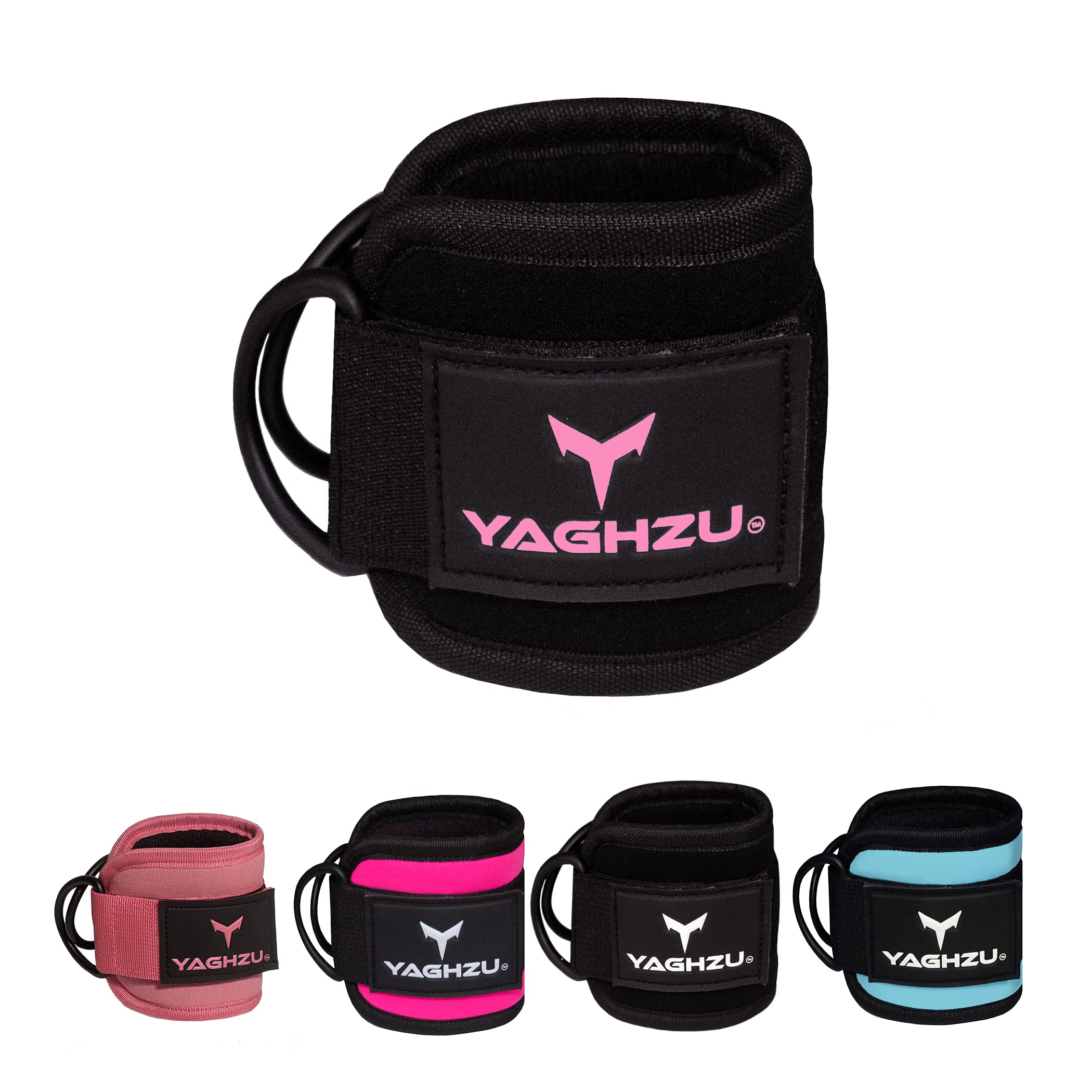
Double-stitched nylon over 7 mm neoprene, a reinforced steel D-ring and a wide hook-and-loop closure: the build reads like hardware rather than a gym accessory, and it's the reason the cuff holds its shape instead of rolling at the edges after a few sessions.

It cinches down on a smaller ankle without a wad of spare strap and still closes over a bigger calf, and at 3.5 oz it's light enough to forget you're wearing it between sets. The wide closure does the work here — there's enough overlap that the pull spreads instead of concentrating at one edge.

A one-year warranty comes with it, and the D-ring takes a standard cable clip without an adapter. On bare skin the nylon edge can rub above the ankle; a thin sock solves it, and the cuff itself doesn't shift once it's set.

Where it beats the other budget singles is exactly that hardware — the reinforced ring and the double stitching are what you'd expect to pay more for. It's the pick for a first cuff or a spare that lives in a gym bag and gets used hard.

Bottom line: A budget single with hardware-grade stitching and a wide closure, and the one we point to when you want one good cuff rather than two cheap ones.

#5

DMoose Ankle Strap

DMoose Ankle Strap

Everyday cable work

Our Score 9.4/10
Check Price

Worth Noting

  • Sold as a single cuff
Weight
4.23 oz
Padding
8 mm neoprene
Hardware
Double stainless D-rings
Pack Size
Single cuff
Read the full review

Two stainless D-rings instead of one is the detail that makes this cuff work. The cable's pull is shared across the whole tab rather than concentrated at a single point, so nothing digs into the ankle when the stack gets heavy. Around that sits 8 mm of neoprene over a nylon shell, at 120 g and 10 by 4 inches.

Of everything here, this is the strap we hand to someone who wants to stop thinking about their equipment. The pad doesn't bunch, the cuff stays where you set it through a full set of kickbacks, and the extra width buys a wider margin before a ring starts to press. For the build, it's also one of the cheaper straps in this group.

Width is where it separates from the thinner cuffs: the pad covers more of the ankle, so the strap sits across the joint instead of on the bone, and it doesn't rotate around the leg between reps. On a very small ankle there's a bit of tail left over, which is a fair trade for the coverage.

The hook-and-loop is the part that ages. The grip holds a heavy stack without creeping, but over months the fabric at the closure edge is where a strap like this starts to look tired. At this price that's a fair exchange, and it's why we treat a cuff as replaceable kit rather than a lifetime purchase.

Bottom line: We tell most people to start here: a wide 8 mm pad, two rings sharing the pull, and a closure that holds a heavy stack without creeping.

#6

Slim Panda Ankle Straps

Slim Panda Ankle Straps

Budget home gyms

Our Score 9.4/10
Check Price

Worth Noting

Weight
5.64 oz
Material
Neoprene, nylon
Pack Size
2 cuffs
Strap Length
18.5 in
Read the full review

At 18.5 inches, the strap on this pair runs nearly twice as long as most cuffs here. That's why it cinches down on a narrow ankle without a fight and still closes around a wider one — 160 g for the pair, neoprene over nylon, with the metal rings sitting outside the pad rather than on it.

Two cuffs for roughly the price of our top pick's single strap is the argument, and it's a good one. For a home cable setup shared by two people, or a gym bag that needs a spare for a partner, this is the pair we reach for. The padding is soft without being bulky and the closure stays put through kickbacks and abductions.

The length has one downside: pulled tight on a small ankle, the tail runs well past the closure and wants tucking. Fold it back on itself and it sits flat. Colors run bright — the pink is genuinely pink — and the stitching looks better than the price suggests.

Bottom line: Two cuffs for roughly what our top pick's single strap costs, with a long strap that cinches down on small ankles and opens up for large ones.

#7

Harbinger Ankle Cuff

Harbinger Ankle Cuff

Sensitive ankles

Our Score 9.4/10
Check Price

Worth Noting

  • Lining traps heat and dries slowly
Lining
Synthetic shearling
Weight
5.6 oz
Closure
Double ring
Pack Size
Single cuff
Read the full review

Synthetic shearling, not neoprene, lines this cuff — a plush fleece against the ankle instead of a foam slab, which makes it the pick for anyone whose ankle bones complain on every other strap here. The closure is mechanical as well: the webbing threads through two steel rings, so the hook-and-loop isn't carrying the load on its own.

It's the most expensive single cuff in this group, and at 5.6 oz it sits heavier on the ankle than the neoprene straps. Two of them is a real outlay, and if you alternate legs set for set you'll feel it at the checkout rather than in the set.

What you get in return is padding that doesn't flatten under a stack, and rings that clip straight onto a standard cable carabiner without an adapter. The fleece is why the cuff still feels cushioned in the last set of a session, when foam pads have compressed to a thin layer.

Bottom line: The one for bony ankles: synthetic shearling instead of foam, and a double-ring closure that takes the load off the hook-and-loop entirely.

#8

HPYGN Ankle Straps

HPYGN Ankle Straps

No-slip kickbacks

Our Score 9.4/10
Check Price

Worth Noting

  • Stitching can fail under heavy use
Weight
4.8 oz
Material
Neoprene
Pack Size
Pair
Foot Strap
Included
Read the full review

A second adjustable strap and a loop that runs under the foot separate this pair from every other cuff here. The idea is simple: the foot strap anchors the cuff to the foot, or to a shoe, so it can't ride up the calf halfway through a kickback.

That's the fix for the thing that annoys us most about ankle straps — the cuff that creeps up between the eccentric and the next rep. The pair weighs 4.8 ounces, the neoprene pad is soft, and the D-rings are metal rather than plastic, so the anchor point doesn't flex under a pull.

The extra strap costs seconds. Threading, tightening and checking takes longer than slinging on a plain cuff, and the hook-and-loop is strong enough that it isn't a quick job. Set them up at the start of a session and leave them on between exercises; that's how the time cost disappears.

If your current cuff slides up on every set, the fuss is worth it — you stop adjusting and start training. If yours already stays put, save the seconds and buy a plain cuff. It's the only strap here that solves slip rather than working around it.

Bottom line: Worth the extra faff if your cuff climbs: the strap under the foot anchors it, so you stop re-seating it between reps.

How We Tested the Best Cable-Machine Ankle Straps

We started by pulling together every ankle strap we could find from fitness brands and general sporting-goods retailers, then narrowed the field to 14 based on strap width, closure type, padding, and the hardware included. We ruled out anything with plastic buckles that looked prone to cracking and anything that only fit one ankle size. Each strap went through a four-month rotation on cable machines at a gym and in a home setup, with the same sequence: glute kickbacks, hip abduction, hamstring curls, and standing leg raises. We used them bare-ankled, over socks, and over a thin high-top to see how fit changed.

Comfort got judged on the fourth set, not the first. We noted whether edges dug in, whether padding shifted, and whether the strap stayed put during fast reps or needed re-tightening between sets. For durability, we checked stitching at the D-ring after every session, watched for Velcro that stopped gripping, and looked for stretched-out nylon or cracked hardware by the end of month four. Suitability came down to the cable attachment: we clipped each strap to a standard carabiner and a spring-link and flagged any that hung awkwardly or twisted the cable path.

Value was the last filter. A budget strap that lasted the whole test and stayed comfortable earned more points than a plusher version that frayed early or only worked with one ankle size. We also compared how easy each was to adjust with one hand and whether the tail stayed out of the way during quick sets. The straps that made the cut are the ones we kept reaching for after the novelty wore off.

How to Choose

One cuff or a pair

Quantity comes before materials, because it changes how a leg session runs. A pair lets you finish a set on one leg and start the other without unthreading anything, which matters if you superset kickbacks with abductions or train both legs back to back. A single cuff is cheaper and perfectly workable if you finish one side completely before switching — you just spend a few seconds unbuckling between sets.

Our best-overall pick ships singly, and the budget pairs start at about the same money, so decide which rhythm matches your workout before you compare anything else.

Rings and closure: what takes the strain

Two D-rings spread the pull across the width of the cuff; a single ring concentrates it on one spot, which you feel most on the front of the ankle. The metal is rarely the failure point. The hook-and-loop is: every strap here depends on it, and it's the part that softens with sweat, chalk and time.

Before you load a heavy set, hang your working weight on the cuff and pull hard once. If the closure creeps or the ring tab lifts, don't trust it for a working set. Check the stitching where that tab meets the cuff too — that seam carries everything the cable pulls.

Padding: thickness, width and your ankle bone

Pads here run from 5.5 mm to 8 mm, but thickness alone doesn't decide comfort. Where the pad sits matters more: a wide 7 mm cuff that covers the ankle bone beats a narrow 8 mm one that leaves it exposed. If your ankles are bony, or a strap has bruised you before, look at a fleece or shearling lining rather than foam.

The trade is heat. Fleece compresses less under load but holds sweat and dries slowly, while neoprene is the better choice for long, sweaty sessions.

Fit, socks and where the cuff sits

"One size" describes the strap's length, not your ankle. Most cuffs run 10 to 11 inches; longer straps fit a wider range but leave a tail to tuck when cinched down small. Set the cuff just above the ankle joint rather than across the top of the foot, and wear a thin sock if the edge rubs — the difference between a comfortable set and a raw ankle is usually one layer of fabric.

What you need to spend

Nothing in this category costs enough to justify a bad fit. The gap between the cheapest cuff and the most expensive buys materials — cotton instead of neoprene, stainless hardware instead of coated steel, a foot strap that stops slip — not a better hold on the cable.

Spend on the pair if you switch legs, on lining if your skin objects, and on the anti-slip design if your current strap climbs. Everything else is a spare you can buy later.

Frequently Asked Questions

Final Verdict

The DMoose cuff is the safest buy for most people: a wide 8 mm pad, two rings spreading the pull, and a closure that holds a heavy stack, all in a single strap that costs less than most of the pairs here. If you alternate legs set for set, buy the Fitgriff pair and save yourself the unbuckling.

If bare-skin comfort is the problem rather than price, Gymreapers' cotton lining or Harbinger's shearling will fix it — those are the two upgrades worth paying for.