Strength & Weights

Best T-Bar Row Machines of 2026

A T-bar row is one of the simplest ways to add serious back thickness to a home gym: you load plates, hinge, and pull. The right machine gives you a stable chest pad, a smooth arc, and a grip that lets you focus on the pull instead of fighting the equipment. But a wobbly base, a pad that hits you in the wrong spot, or handles that are too wide can turn a good movement into a shoulder ache. We spent seven months with eight T-bar row setups to find the ones that get out of your way.

I've used landmine attachments, standalone units, and compact benches that double as row stations, and the difference between a productive set and a frustrating one usually comes down to fit and grip. Quality and durability matter, but so do range of motion, versatility, and value—a machine that develops play in the pivot after a few weeks isn't a bargain. The picks below are the ones that stayed stable under load and let my elbows travel naturally; if you're outfitting a garage gym or upgrading a corner of the basement, start here.

#1

Yes4All T-Bar Row Platform

Top Pick
Yes4All T-Bar Row Platform

Heavy home-gym rows

Our Score 9.4/10
Check Price

Worth Noting

  • Rack mount fits 2x2 legs only
  • Olympic sleeve can be loose on thin bars
Swivel
360 degrees
Mounting
Floor, wall, or 2x2 rack
Weight Capacity
880 lb
Bar Compatibility
1-inch and 2-inch bars
Read the full review

The first thing we check on a T-bar setup is whether the pivot stays put when the bar gets heavy, and the Yes4All platform is built around that job. Its alloy steel base is rated to 880 pounds and can be mounted to the floor, a wall, or a compatible rack, so the bar pivots from a fixed point instead of skating around the garage. That is the difference between a row you can load and one you have to chase.

The 360-degree swivel is a bigger deal than it sounds. It lets the bar travel through a natural arc for rows, presses, and single-arm work, and the platform accepts both 1-inch standard and 2-inch Olympic bars. That makes it a useful bridge if you started with a standard bar and plan to move to Olympic later. We also like that the base is compact enough to leave in place without eating a whole corner.

Think of it as the anchor rather than the whole rowing station: the bar still supplies the load, and a V-handle is worth adding if you want a neutral grip. What sells it for us is the combination of a high weight rating, a low mounting profile, and a pivot that moves freely. For a home gym that can dedicate a few square feet to a permanent station, it is the most dependable foundation here.

Bottom line: Buy the Yes4All if you want a bolted-down landmine base that handles heavy rows and accepts both standard and Olympic bars; it is the most stable foundation here.

#2

HXD-ERGO Landmine Attachment

HXD-ERGO Landmine Attachment

Portable landmine setup

Our Score 9.2/10
Check Price

Worth Noting

  • Lower 450 lb ceiling than mounted bases
Weight
12.8 oz
Mounting
No installation required
Weight Capacity
450 lb
Bar Compatibility
2-inch Olympic bars
Read the full review

The HXD-ERGO is the base we point to when drilling into a garage floor is not an option. It weighs 12.8 ounces, needs no rack or bolts, and sits on a honeycomb rubber pad that is meant to hold on wood, concrete, tile, or carpet. You slide it onto a 2-inch Olympic bar and start rowing.

We like that it turns a barbell into a landmine without a permanent installation. The 450-pound capacity is more than enough for most home rows, and the small footprint means it can live in a corner or go in a bag. It is a portable base, though, so it depends on floor grip rather than bolts. A textured rubber mat or a corner helps, and a smooth floor is the wrong surface for an aggressive set.

That is the trade-off, and it is a reasonable one for renters, apartment lifters, or anyone who has to clear the floor after training. There is no hardware to lose and no template to line up, which is why it works in a spare room. If your setup stays put, the mounted Yes4All is the more secure buy. If it has to move, this is the portable base we choose.

Bottom line: Choose the HXD-ERGO if you need a landmine base that sets up without tools and moves between rooms; just give it a textured floor or a corner.

#3

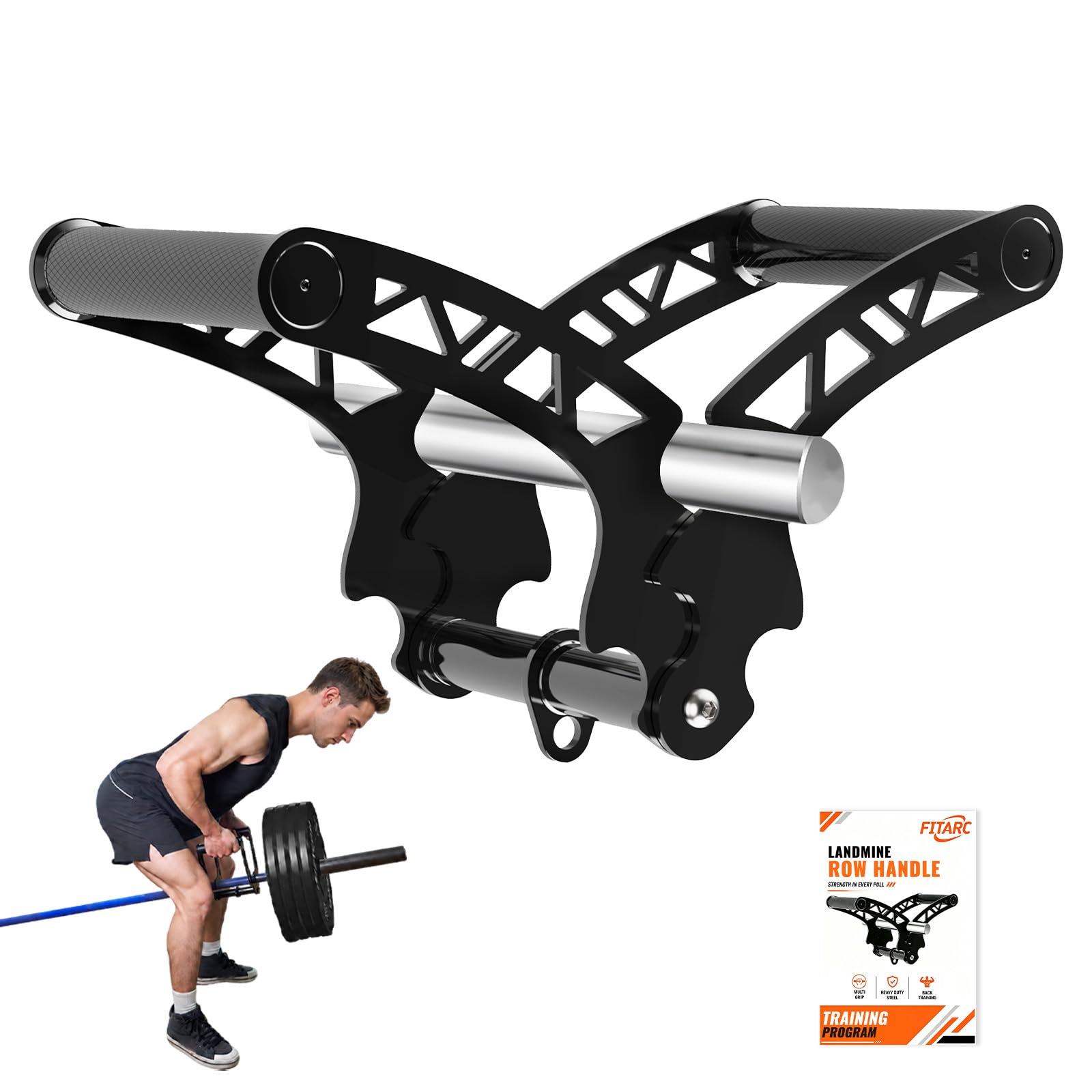
Fitarc Landmine Row Handle

Fitarc Landmine Row Handle

Multi-grip barbell rows

Our Score 9.2/10
Check Price

Worth Noting

  • Requires a separate landmine base
  • Slim 1-inch grips may not suit large hands
Weight
3 lb
Material
Iron
Grip Type
Knurled
Grip Widths
15.7, 11.8, and 7.8 inches
Read the full review

The Fitarc handle solves a specific problem: you already have a landmine base, but the fixed V-handle you own puts your hands in one place. It offers 15.7-, 11.8-, and 7.8-inch grip widths, so you can switch from a close neutral row to a wider pull without changing attachments. That is the most grip range in this group.

We like the all-metal build and knurled grips for sweaty sets. The extended frame keeps the bar from hitting your chest at the top of a row, which is a small design choice that makes a full range of motion easier. It clips onto the bar and can stay there between sets, so you are not re-racking it every time.

The 3-pound weight is light enough to hang on a rack hook, and the 17.7 by 5.5 by 3.3-inch frame is compact enough to store on a shelf but long enough to give your hands room. For a home gym with an existing landmine base, it is the most flexible handle here for back training.

Bottom line: The Fitarc is our pick if you already own a landmine base and want one handle for close, medium, and wide rows; it is versatile, solid, and easy to live with.

#4

SELEWARE T-Bar Handle

SELEWARE T-Bar Handle

T-bar and V-bar

Our Score 9.2/10
Check Price

Worth Noting

  • Requires a separate landmine base
  • Fits 2-inch Olympic bars only
Locking
Locking nut
Handle Grip
1.5-inch rubber
Grip Positions
Close and wide
Bar Compatibility
2-inch Olympic bars
Read the full review

SELEWARE's handle is for the lifter who wants both a close-grip V-bar and a wider T-bar without buying two attachments. It fits 2-inch Olympic bars, tightens with a locking nut, and has a swivel so the handle can rotate with the bar. The rubber grips are 1.5 inches in diameter, which is comfortable for most hands.

We appreciate the locking nut. A lot of clip-on handles depend on friction alone, and the SELEWARE feels more deliberate when you set it. The close grip is 9 inches, and the wide grip gives you a different rowing angle; switching between them is quick. The swivel is a real plus for close-grip sets because the handle follows the bar instead of fighting it.

That makes it a good buy for someone who has a landmine base and wants a premium, multi-grip handle for rows and presses. If you only row with a neutral grip, the Fitarc covers three widths for less. If you want the T-bar option too, this is the one to get.

Bottom line: The SELEWARE is for the lifter who wants one well-built handle that switches between close V-bar and wide T-bar rows; it is the premium multi-grip option here.

#5

Lovind V-Bar Handle

Lovind V-Bar Handle

Foldable travel handle

Our Score 9.2/10
Check Price

Worth Noting

  • Can shift during non-row movements
Design
Foldable double-D
Bar Fit
Most standard Olympic bars
Material
5 mm steel
Cable Use
Yes
Read the full review

The Lovind handle is a space-saving shape: a foldable double-D bar that clips onto most standard Olympic barbells and can also be used on a cable machine. The frame is 5 mm steel with a painted finish, and the grips are rubber-coated for sweaty hands.

We like it for a small home gym because it does two jobs. On the barbell, it gives you a neutral double-D grip for rows; on a cable stack, it works for pulldowns and rows without a separate attachment. The foldable design also means it can hang on a peg or sit in a drawer rather than taking up rack space. The clip-on fit is handy because the handle stays on the bar between sets.

The package is 7.8 by 7.48 by 3.31 inches and weighs 1.29 kg, so it stores easily in a drawer or gym bag. That makes it a fair choice if your training space is tight or you already use a cable stack. If you only want a barbell row handle, a fixed steel model is the more focused choice.

Bottom line: The Lovind is the compact choice for a small gym: a foldable double-D handle that works on a barbell and a cable stack, provided you check the fit.

#6

ZUKAM Viking Press Handle

ZUKAM Viking Press Handle

Viking press rows

Our Score 9.0/10
Check Price

Worth Noting

  • Requires a separate landmine base
  • Needs a smooth-ended bar for a secure fit
Material
Steel
Grip Positions
3
Package Weight
13.2 lb
Bar Compatibility
2-inch Olympic bars
Read the full review

The ZUKAM is the most substantial handle in this group, and it is built for more than rows. It has three grip positions, fits 2-inch Olympic bars, and uses a knob to clamp onto the bar. The steel frame and black paint give it a commercial-gym look.

We like it for Viking presses and multi-grip rowing, where the extra handle positions let you change your line of pull. The package weight is 5.97 kg, so it feels like a serious piece of kit rather than a plastic accessory. It is also easy to assemble, which matters in a garage gym.

The package is 17.24 by 11.26 by 5.63 inches, so it takes up more shelf space than the compact handles here. That makes it a good choice if you want one heavy-duty handle for pressing and rowing, rather than a compact row-only tool. The Fitarc is easier to live with if all you do is row; the ZUKAM is the one for a broader upper-body session.

Bottom line: The ZUKAM is for the lifter who wants a heavy, multi-grip handle for Viking presses and rows; pair it with a landmine base and a smooth bar.

#7

EVERSTRONG T-Bar Row

EVERSTRONG T-Bar Row

No-drill small spaces

Our Score 8.8/10
Check Price

Worth Noting

  • Won't accept many bumper plates
Swivel
360 degrees
Mounting
No-drill plate base
Plate Setup
Two 25, 35, or 45 lb plates
Bar Compatibility
2-inch Olympic bars
Read the full review

The Everstrong T-bar row is the no-drill option that does not rely on a rubber pad. It uses two 25-, 35-, or 45-pound plates as the anchor, then adds a 360-degree swivel and a V-bar handle. That makes it a complete rowing station in a small space, as long as your plates fit.

We like the idea for a garage gym with no free wall: you are not bolting anything down, and the plates come off so the base can be moved when you need the floor. The V-bar gives you a neutral grip, and the swivel lets the bar arc naturally. It is also one of the few setups here that includes the handle and the pivot in one purchase.

The plate fit is the catch. The base is too large for some standard Olympic plates, and a plate-anchored design depends on the plate sitting inside the base correctly. Measure the plate diameter and center hole before you order.

If your plates are the right shape, this is a clever space-saver and a genuinely complete setup. If they are not, a mounted platform or a separate handle is the safer route. That is why we place it as a runner-up rather than the default: it is excellent for the right plate collection, not universal.

Bottom line: The Everstrong is a smart pick for a small garage gym if your plates fit its base; it gives you a complete no-drill rowing station with a V-handle and swivel.

How We Tested the Best T-Bar Row Machines

We started by sorting every T-bar row setup we could find into three groups: standalone machines, landmine attachments, and benches with a built-in row station. We ruled out anything with vague load ratings, missing footplate specs, or a handle width that didn't suit a normal shoulder-width pull. That left eight units, which we used for seven months in a garage gym and a basement corner.

Each setup got the same weekly routine: three back sessions, one lighter technique day, and a few sessions where I supersetted rows with presses so I'd notice any wobble when I was already tired. We loaded and unloaded plates repeatedly, switched grips between wide, neutral, and close, and noted whether the chest pad landed at sternum height or pushed my shoulders forward. I also checked whether the footplate stayed put during heavier sets, whether the handles rotated smoothly, and whether my elbows could travel past my torso without the handles bottoming out. The best setups also handled a landmine press or a single-arm row without feeling like a compromise.

After every session we looked for play in the pivot, slipping on the footplate, and wear on the pad. We tracked whether the finish held up where plates slid on and off, and whether the frame stayed tight after repeated loadings. To judge value, we compared what each unit included—handles, footplate, storage—against what it asked you to add separately, and we noted which setups still felt solid after seven months rather than just on day one.

How to Choose

Base, Handle, or Complete Setup

A T-bar row attachment can mean three different things: a mounted platform that anchors the bar, a portable base that sits on the floor, or a handle that clips onto the bar. The handle is the part you pull, but the pivot is what makes the movement possible. If you do not already have a landmine base or a rack sleeve, buy the base first; a handle alone will not give you a T-bar row.

Mounted platforms such as the Yes4All are the most secure for heavy loads. Portable bases such as the HXD-ERGO suit renters and shared rooms. Plate-anchored designs such as the Everstrong sit between the two: no drilling, but they depend on your plates fitting the base. Decide which of those constraints you can live with before you compare grips.

Measure the Bar, Rack, and Plates

Most handles are built for 2-inch Olympic bars, while some platforms accept both 1-inch standard and 2-inch Olympic bars. Measure the bar sleeve, not the plate hole, and check the inside of any clamp or sleeve. A listing that says 2 inches may be describing the outside of the tube, which is not the same thing.

Rack-mounted bases add another measurement: the rack leg. The Yes4All mount is sized for 2x2 legs, so a 2.3-inch leg will not fit without a different plan. Plate-anchored bases need a plate diameter check, especially with bumper plates. Two minutes with a tape measure saves a return.

Match Weight Capacity to Your Rows

A mounted platform can carry more load than a portable base, but the number on the box is only part of the story. The Yes4All is rated to 880 pounds; the HXD-ERGO is rated to 450. The portable base is fine for most home rows, but it relies on floor friction, so a smooth floor and a heavy pull are a bad combination.

Handles do not add stability; they only change your grip. If you row heavy, put more of your budget into the pivot and less into the handle. If you row moderate weights and need to clear the floor, a portable base is the better trade. Inspect welds, clamps, and locking nuts before you load up.

Choose a Grip for Your Training

A fixed V-handle is simple and comfortable for neutral-grip rows. A multi-grip handle such as the Fitarc lets you move between close, medium, and wide positions; the SELEWARE adds a T-bar option with a locking nut. More grips are useful if you press and row, not just row.

Knurled steel grips suit dry hands and heavy loads; rubber grips are gentler on the palms and better for sweaty sessions. A 360-degree swivel is worth having if you want presses, rotations, or single-arm work. If you only do bent-over rows, a fixed handle is enough and easier to live with.

Frequently Asked Questions

Final Verdict

The Yes4All platform is our overall pick because it gives you a stable, 880-pound-rated pivot that mounts to the floor, wall, or a 2x2 rack and swivels through 360 degrees. If you cannot drill, the HXD-ERGO is the portable base we recommend; if you already have a landmine base, the Fitarc handle covers three grip widths. The Everstrong is the no-drill complete setup when your plates fit. Start with the pivot, then choose the grip that matches your training.