Tech & Wearables

Best Open-Ear Headphones for Running of 2026

The tradeoff with running headphones is built into the design: seal off your ears for bass, and you seal off the car rolling out of a driveway along with it. Open-ear pairs skip that deal — they sit outside the ear canal, so music rides underneath the world instead of on top of it. If you have ever pulled a bud out mid-run to check whether that noise behind you was a car, you already know what this category is for.

There are two ways to build one, and they do not sound alike. Bone conduction models vibrate against your cheekbones and leave the ear wide open; clip-on and hook-style buds aim sound at the ear from just outside it, which usually means more low end. We spent six months running in 12 pairs of both kinds, on pavement, treadmills, and gym floors.

Two things caught me out. Battery numbers on the box are honest but conditional — volume is what eats them. And a fit that feels great in mile one can turn into temple pressure by mile eight, so comfort has to be judged late. The picks below survived that.

#1

SHOKZ OpenRun

Top Pick
SHOKZ OpenRun

Road running

Our Score 9.0/10
Check Price

Worth Noting

  • Band and button failures show up over months
  • Proprietary magnetic charging cable
Weight
0.92 oz
Fit Style
Bone conduction band
Battery Life
8 hours
Water Resistance
IP67
Read the full review

Two numbers make the case: 26 grams and IP67. The weight is why the OpenRun disappears somewhere in the second mile, and the rating is the highest water resistance of any band here, which matters because sweat is what actually kills running headphones. Nothing else in this group gets both, and that is why it is the pair we recommend first.

The frame wraps behind your head and hooks over your ears, holding the transducers in front of the canals so traffic, footfalls, and a cyclist's warning all come through. On a busy road that is the whole point. We also like how little there is to adjust: you set it once and stop thinking about it, which is more than we can say for the clip-ons that need a small ritual every time you put them on.

Shokz claims eight hours, and the quick-charge top-up is more useful than it sounds, since ten minutes on the cable is rated for up to an hour and a half of running. Volume is the compromise you accept with bone conduction. At a windy junction you will have the button most of the way up and there is not much left after that, though the app's EQ modes buy a little more.

The band does cross behind your head, so a pulled-up hood or a bike helmet's rear cradle can nudge it out of place. If most of your miles are on two wheels, a clip-on sidesteps that entirely. For road running in a cap, the OpenRun sits where you put it.

Bottom line: The pair we recommend first: IP67 sealing, a 26-gram frame that stays put, and enough awareness to hear traffic. If you want one set of running headphones and no second thoughts, buy these.

#2

Soundcore V20i

Soundcore V20i

All-day wear

Our Score 8.8/10
Check Price

Worth Noting

  • Comfort varies; the hook can press behind the ear
  • One earbud sometimes stops working
Playtime
8 hours, 36 with case
Fit Style
Rotating ear hook
Driver Size
16 mm
Water Resistance
IP55
Read the full review

The hook rotates through four positions, and after a week of runs we stopped thinking about it, which is the highest compliment a running headphone gets. Getting there took a couple of tries: swing the hook too far and the driver sits off your canal and the sound thins out; one notch back and it is full again.

That adjustability is the reason to pick it over a fixed clip-on. Ear shapes vary, and a pair you can dial in is a pair that stays put through a hill session and still feels fine three hours into a flight. The 16 mm drivers are the biggest in the true-wireless group here, and they carry bass the bone-conduction bands cannot touch.

Battery runs eight hours per charge and 36 with the case, and multipoint keeps a phone and a laptop connected at once, which is genuinely useful if these do double duty as work headphones. The case is the biggest of the earbuds here, and that is the price of the reserve: it lives in a bag rather than a pocket.

Bottom line: For one pair that covers runs, calls, and a full workday, this is our pick: four hook positions, 36 hours in the case, and multipoint that keeps two devices live.

#3

SHOKZ OpenRun Pro 2

SHOKZ OpenRun Pro 2

Long training days

Our Score 8.6/10
Check Price

Worth Noting

  • IP55 rather than the OpenRun's IP67
Weight
1.07 oz
Fit Style
Bone conduction band
Battery Life
12 hours
Water Resistance
IP55
Read the full review

There are two drivers in each earpiece: the bone-conduction transducer that carries mids and highs, and a small air-conduction driver that handles the low end. The result is music with a bottom to it, drum patterns and basslines you can follow instead of a wash of guitar and vocal, which is the thing bone conduction has always been worst at.

That is why this is the one we point to when the playlist matters as much as the run. Twelve hours of playback covers a training week or one very long race day, and the app's Classic mode returns to straight bone conduction for anyone who finds the extra low end distracting on a busy road.

Calls run through dual wind-resistant mics, and it holds two devices at once, so a watch and a phone both stay connected without re-pairing between them. At 30.3 grams it is the heavier of the two Shokz bands here. You feel it for the first mile and then you do not, which is a trade we take for the extra driver and the extra four hours.

Bottom line: The best-sounding open-ear set here: a second driver adds the bass bone conduction cannot make, and twelve hours covers a marathon build. Worth it for anyone training long and listening closely.

#4

Soundcore C50i

Soundcore C50i

Glasses and helmets

Our Score 8.4/10
Check Price

Worth Noting

  • Shortest battery life of the earbuds here
  • Bluetooth can drop out mid-run
Playtime
7 hours, 28 with case
Fit Style
Clip-on
Driver Size
12 mm
Water Resistance
IP55
Read the full review

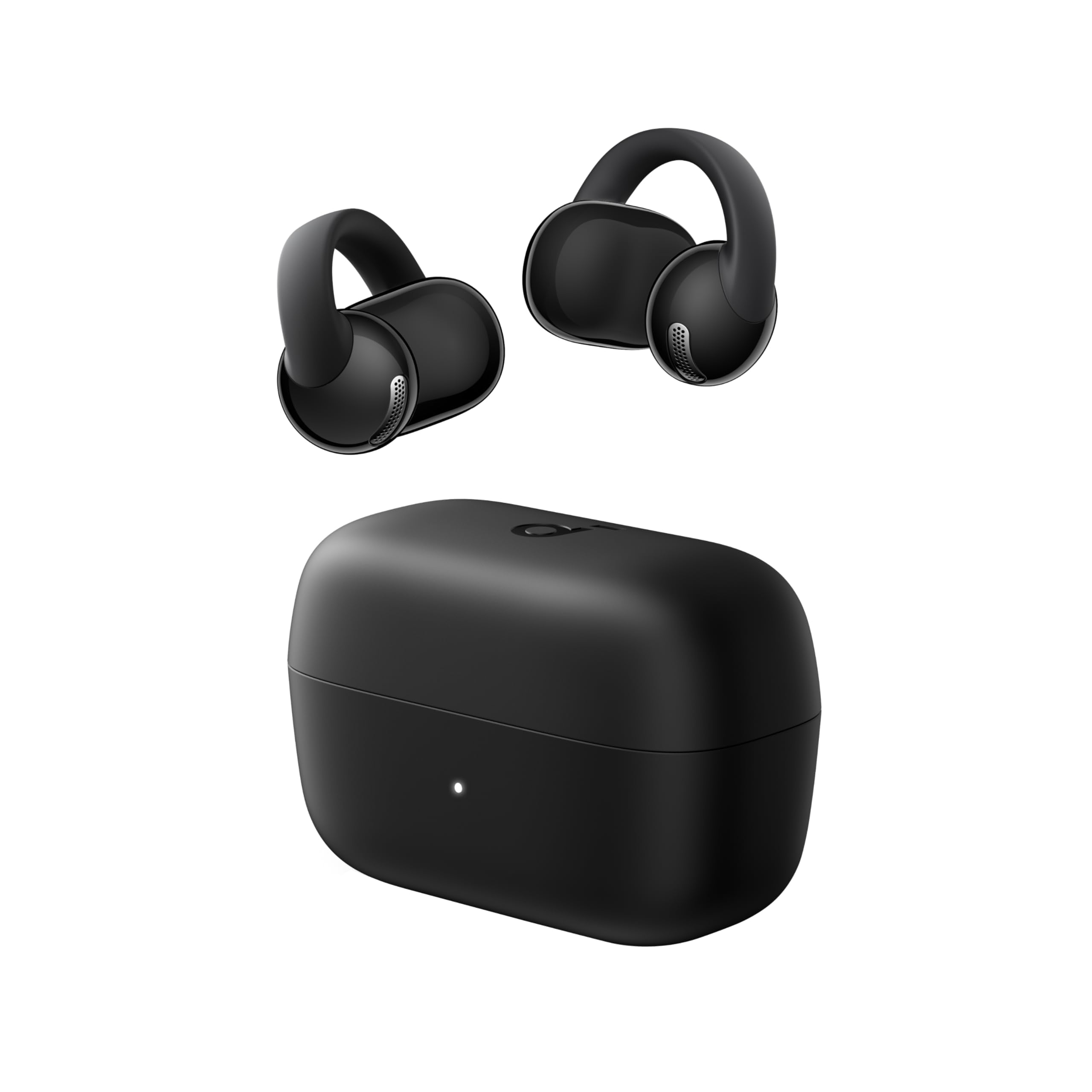
If you run in sunglasses, a high ponytail, or a bike helmet, this is the pair that solves your problem: nothing crosses the back of your head, so the arms of your glasses sit exactly where they always do. The FlexiClip arm hooks over the ear and holds a 12 mm driver just outside the canal, and the memory-titanium wire inside it bends to your ear shape.

Two small pieces and a case that fits a shorts pocket make it the easiest of these to live with, with no band to argue with a hood and no bulk behind your head. The 12 mm drivers are the largest of any clip-on here, and bass is the reason: kick drums land with weight rather than a tap. What you give up is the open, room-filling quality of a bone-conduction band. This sounds like a small speaker next to your ear, because that is what it is.

Calls are the other place it earns its keep. AI noise filtering keeps voices clear indoors, which is why ours has done double duty on conference calls as well as easy runs. Outdoors in wind, the person on the other end hears it, so duck behind a building before you dial in.

Bottom line: What we tell glasses wearers: this clip-on clears your frames and your helmet strap, stays put through sweat, and packs into a pocket. Start here if a band gets in your way.

#5

PSIER X12

PSIER X12

Budget bone conduction

Our Score 8.2/10
Check Price

Worth Noting

  • IPX5 rather than IP67 sealing
Weight
0.81 oz
Fit Style
Bone conduction band
Battery Life
10 hours
Water Resistance
IPX5
Read the full review

No app, no EQ modes, no touch panel. The X12 is a bone-conduction band stripped down to the parts that matter on a run: a 23 g memory-titanium frame, push buttons, and ten hours of playback at moderate volume.

Pairing is quick, the buttons work through a wet glove, and the flex in the wire lets it sit on a range of head sizes without a mini version. The adjustable strap in the box takes up the slack if the frame runs loose on a smaller head. At 23 g it is the lightest band here, and the difference shows up late in a long run, when the heavier frames start to press.

Sound is where the saving shows. You get the same hear-the-road awareness as the Shokz bands, but there is less weight in the low end, and the treble sharpens when you push the volume up against a headwind. Bone conduction is about awareness first and fidelity second, and at this price the trade is fair.

Bottom line: The bone-conduction band for a cautious first buy: 23 grams, ten hours, and the same hear-the-road awareness, with thinner sound and no app to manage.

#6

TOZO OpenEarRing

TOZO OpenEarRing

First open-ear pair

Our Score 0.0/10
Check Price

Worth Noting

  • No published IP rating for water resistance
  • Charging faults and shell failures over months
Playtime
10 hours, 40 with case
Fit Style
Clip-on
Driver Size
10 mm
Water Resistance
Water resistant
Read the full review

Forty hours of total playtime, a digital battery readout on the case, and a ring that sits over the ear instead of in it: the OpenEarRing is priced like an accessory and specified like a main pair. Ten hours come from the buds themselves, and the case adds the rest.

The ring leaves the canal open, so you get the road awareness of a bone-conduction band without anything pressing on your cheekbones, and a cap does not interfere with it the way a headband can. Thick glasses frames are the exception, since they crowd the space behind the ear where the ring wants to sit.

Sound is the surprise. The 10 mm drivers go loud and stay clear, and the app adds 32 EQ presets for anyone who wants to tinker. The touch panels are the fiddly part: we spent the first week hitting the wrong spot, and gloves make it worse, so plan on the app or your phone for volume mid-run.

Where that leaves our recommendation: it is the easiest yes on this page. The money is small, the case does most of the work, and the sound is good enough that you will not spend the run thinking about what you saved.

Bottom line: The least expensive way into open-ear running: loud, clear sound, forty hours of reserve in the case, and a clip that stays on. Worth it before you spend more.

How We Tested Open-Ear Headphones for Running

We started with a list of roughly 40 open-ear models sold for running, then cut it down by format, published water-resistance rating, claimed battery life, and whether the maker listed a weight at all. Twelve made the cut, spanning bone-conduction bands, clip-on buds, and hook-style pairs, and we ran in every one of them for six months.

Testing happened where these things actually live: early road runs before traffic woke up, treadmill intervals, a stretch of wet-weather runs, and a few gym sessions. Each pair went out on at least a dozen runs. I queued the same podcast episode and the same three songs on every model, once on a quiet path to hear detail and once beside a busy road to hear how much traffic bled in — that second listen is the whole reason to buy open-ear in the first place.

To check fit, I shook my head hard, sprinted a block, and went out wearing sunglasses and then a winter hat. Comfort got judged at 45 minutes and again at 90, since temple pressure shows up late. For battery, every pair was charged to full and run at about 70 percent volume until it died, with the hours logged against the claim. For durability and reliability, pairs were rinsed under a faucet after sweaty runs, wiped down, and tossed loose into a gym bag, and I noted any dropout, crackle, or control that stopped responding over the six months. Pairing was tested against a phone and a laptop, then switched between the two mid-run to see how cleanly the handoff went.

How to Choose Open-Ear Headphones for Running

Fit Style Comes First

The headband, the ear hook, and the clip-on solve the same problem three ways. A bone-conduction band wraps behind your head and holds its transducers in front of the ear. It is the most set-and-forget of the three and the hardest to dislodge, which is why the OpenRun is our default. The cost is a band that argues with a pulled-up hood, a bike helmet's rear cradle, and some high ponytails.

Hooks and clip-ons are true wireless: two separate pieces, a case to carry, and nothing behind your head. A clip-on sits over the ear and leaves glasses arms alone, so if you run in shades or a helmet, start there. Hooks suit ears that never get along with clips, provided you are willing to dial in the position.

Read the Water Rating Properly

IP ratings are two digits: dust first, water second, and an X means the maker did not test for dust. IPX5 handles sweat and sprayed water, IP55 adds dust protection, and IP67 survives a dunk. Sweat is the killer here rather than rain, because salt sits on the charging contacts and quietly corrodes them between charges.

Match the number to the runner. A heavy sweater, or anyone training through a rainy winter, should look at IP67 like the OpenRun's. Everyone else does fine at IP55, as long as the contacts are wiped dry before the headphones go back on the charger or into the case.

Volume Is the Real Trade-Off

Open-ear designs give up isolation on purpose, and on a windy road you cannot simply turn them up. Bone conduction runs out of headroom sooner than an in-ear bud, and cranking it costs battery and clarity. That is the honest bargain: you hear your music, and you hear the truck behind it.

Look for an app with EQ or a bass mode if you want more punch, and accept that a headwind at speed will win. The earplugs that ship with some bone-conduction kits are for a noisy gym or a treadmill, never for a road with traffic on it.

Match Battery to Your Week

Eight hours of playback is roughly a week of 45-minute runs, so the headbands here get charged about as often as you do laundry. True wireless pairs split the number: seven to ten hours in the buds, then 28 to 40 hours in the case, which is what actually decides how often the cable comes out.

We care more about the case than the per-charge figure, because the case is the part you carry. A big one lives in a bag; a small one goes in a shorts pocket. If you are the type to leave the charger at home, buy case capacity.

Frequently Asked Questions

Final Verdict

The SHOKZ OpenRun is the pair we point most runners to. IP67 sealing, 26 grams, and awareness that turns a busy road from a gamble into a known quantity, all in one band, and nothing else here gets all three. Its weak point is long-term durability, so buy it knowing the band is not forever.

Two runners should look elsewhere. In glasses or a helmet, the Soundcore C50i sidesteps the band entirely. If the music matters more than the miles, the OpenRun Pro 2's dual drivers and twelve hours are worth the step up.