Strength & Weights

Best Weighted Vests of 2026

A weighted vest turns a walk, a stair climb, or a set of push-ups into more work without adding a barbell to your living room. The trick is that the extra load should feel like effort, not punishment. I've worn enough vests that slid off my shoulders, bounced against my chest, or smelled like a tire store to know the difference, and our team has now spent six months with 12 of them to sort the good from the annoying.

What mattered most was weight — whether the listed pounds felt honest and evenly placed — plus fit and size across body types. Some vests run boxy and short; others swallow your torso. We also checked quality and value: stitching, closures, and whether the thing still looked and smelled decent after repeated sweaty sessions. The picks below are the ones I'd actually grab for a dog walk, a weekend ruck, or a living-room circuit.

#1

ERIC FLAG 40 lb

Top Pick
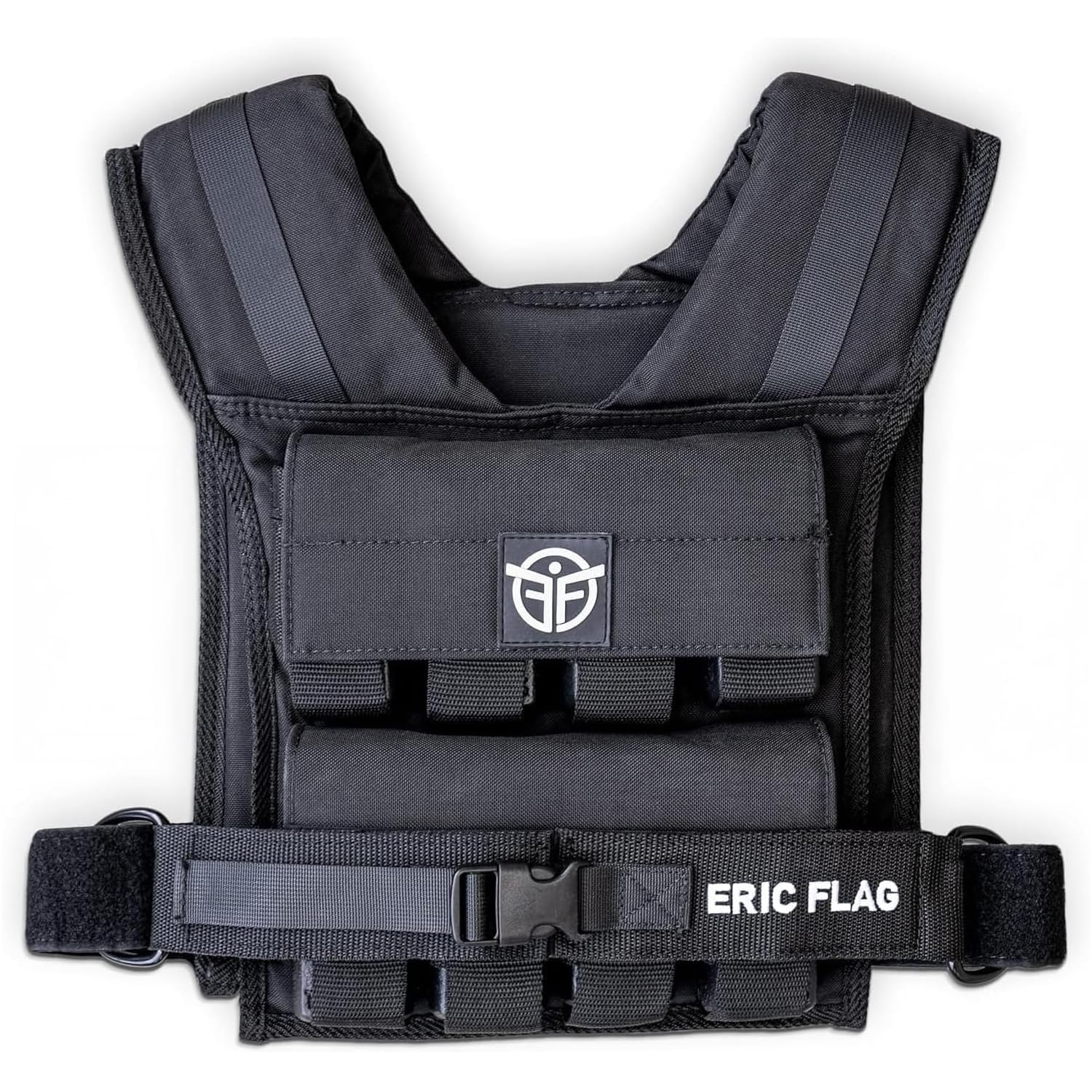
ERIC FLAG 40 lb

Heavy strength work

Our Score 9.4/10
Check Price

Worth Noting

  • 2.4 lb increments leave little fine-tuning
  • One strap, so fit depends on cinching
Shell
1000D Oxford nylon
Plates
16 x 2.4 lbs iron
Max Load
40 lb
Empty Weight
1.6 lb
Read the full review

Eric Flag asks more money than anything else here, and in return it is the only vest in this group that will still be hard work a year from now. Sixteen 2.4-pound iron plates sit in individual pockets, eight across the front and eight across the back, and the vest runs from a 1.6-pound empty shell up to a full 40 pounds.

That range suits strength work rather than walking. Weighted pull-ups, dips, push-ups and squats are where 40 pounds earns its keep, and the 1000D Oxford shell is the toughest fabric in this roundup — the class of nylon used in heavy packs. Plates held in separate pockets mean the load stays where you put it when you hinge at the hips, and the single wide strap and buckle leave your arms free overhead.

Loading it is a small ritual: sixteen plates, each into its own pocket, best done before you are already late for a session. Strip it back and the empty shell weighs almost nothing, so it packs into a gym bag between workouts. It is the one piece of gear here that gets more useful as you get stronger.

Bottom line: Buy this one if you intend to get strong with it: 40 pounds in removable plates is capacity nothing else here can match.

#2

RUNmax 20 lb

RUNmax 20 lb

Broad shoulders

Our Score 9.4/10
Check Price

Worth Noting

  • No shoulder padding on this version
  • Tops out at 20 lbs
Load
20 lb
Shell
1000D nylon
Weights
Removable
Fits Chest
28 to 48 inches
Read the full review

RUNmax does the trick we like most in this category — individual weights you can pull out — for noticeably less than the Sportneer, and it wraps them in a tougher shell. The weights sit in Velcro pockets, the outside is 1000D nylon, and quick-release buckles close the straps.

The number that decides it is the chest range: 28 to 48 inches, the widest of anything here. That covers the broad shoulders and bigger frames the one-size neoprene vests cut into, and it tightens down far enough for a slim adult. We rate a genuinely adjustable fit above a few extra pounds of load, because a vest that will not cinch is a vest that hangs in the closet.

There is enough strap tail to wear it over a hoodie on a cold morning, and the webbing sits straight on your shoulders, so sleeves help. Cinch the waist strap and it holds through a jog; leave it loose and you will feel the hem lift. RUNmax backs the vest with a lifetime warranty against defects, which is more than most of the budget picks here offer.

Bottom line: We like it as the value route to removable weights, especially if your chest falls outside the one-size norm.

#3

Sportneer Adjustable

Sportneer Adjustable

Everyday all-round training

Our Score 9.2/10
Check Price

Worth Noting

  • Stops at 18 lbs, so heavy rucking is out
Shell
Neoprene
Closure
Zipper with shoulder and waist locks
Weight Packs
8x 2 lbs and 1x 1 lb
Adjustable Load
2-18 lbs
Read the full review

The Sportneer is the vest we point most people to, and the reason is that the weight comes out. Eight 2-pound packs and a 1-pound pack lift out of their individual pockets, so you can start with two loaded and add the rest as your legs catch up, and the shell can be washed rather than wiped once it is empty.

The rest of the design follows that logic. A zip runs down the front, so it goes on like a jacket instead of over your head, and there are locks at the shoulders and at the waist — the second one is what keeps the hem from riding up when you lengthen your stride. Two places to take up slack is what makes the fit work across a range of bodies, and it sits flat enough to wear under a winter coat, which is unusual for a vest with this much padding. The reflective strips run across the front and the back.

Filling it is the one chore. The pockets are cut close, so each pack takes a shove and a full load takes a few minutes to assemble; we tend to leave ours loaded between sessions. The shoulder straps can bite if you wear it over a tank top, and a t-shirt settles that.

Bottom line: Our pick for most people: the load comes out in packs, so you can start light, build up, and wash the shell properly.

#4

BAGAIL Comfort-Fit

BAGAIL Comfort-Fit

Comfortable curvy fit

Our Score 9.2/10
Check Price

Worth Noting

  • Fixed 10 lb load, so no progression
  • Spot-clean only, since the load stays in
Load
10 lb
Shell
Iron sand and neoprene
Closure
Buckle straps
Carry Pouch
Detachable phone pouch
Read the full review

Most vests here are cut like a barrel and rely on straps to pull them in. The BAGAIL is shaped instead: the front panels curve over the chest rather than flattening it, and the buckle straps tighten at the chest and the waist separately. The load is iron sand in a neoprene shell, fixed at whatever weight you order.

That shaping is the reason to buy it. A vest that presses across the bust or rides up toward the collarbone gets abandoned, and this one stays where you put it through a walk or a light circuit. It also has the easiest closure of the fixed-load vests — a clip you can work one-handed — and the extra strap length actually gets used on heavier frames, which is not true of most one-size designs.

The extras are modest but thought through: a phone pouch that clips off when you do not want it, and reflective strips front and back for early or late walks. Nothing about it feels like a compromise at the price.

Bottom line: We recommend it to women and heavier frames who want a vest that sits right on a daily walk; the shaping is the whole point.

#5

Zikopomi Weighted Vest

Zikopomi Weighted Vest

Cheap daily walking

Our Score 9.2/10
Check Price

Worth Noting

  • Doesn't cinch small enough for narrow frames
Load
12 lb
Shell
Neoprene and iron sand
Straps
Two adjustable elastic straps
Visibility
Reflective strips front and back
Read the full review

Zikopomi sells near the bottom of the price range here, and it gets the two things that matter at that end right: two adjustable elastic straps instead of one, and reflective strips across the front and the back. The 12-pound load is iron sand in a double-stitched neoprene shell.

It goes on and off in a second, and the elastic in the sides hugs your ribs once the straps are tight instead of hanging off your shoulders. Weight is split front to back so it does not pull you forward, and the fabric is soft enough to wear over a t-shirt without chafing.

What it cannot do is run. Anything more dynamic than a fast walk sets it moving, so it is a walking, chores and light-weights vest. At this price we are happy to accept that, and it is the one we hand to someone who is not sure yet whether a vest will stick.

Bottom line: We keep it on the list because it costs so little and still does the basic job for walks, chores and light workouts.

#6

ZELUS Weighted Vest

ZELUS Weighted Vest

Walking and chores

Our Score 9.0/10
Check Price

Worth Noting

  • Chemical smell needs days of airing
  • Shifts during jumping and fast footwork
Load
12 lb
Shell
Iron sand, SBR, spandex
Closure
Adjustable buckle straps
Fits Chest
31.5 to 45 inches
Read the full review

Zelus publishes a chest range — 31.5 to 45 inches — which is more than most vests here tell you, and it is the first thing we check. Two buckle straps give you something to work with at either end of that span, and the load is iron sand sealed into a spandex shell rather than packed into pockets you can empty.

It is comfortable the way a good walking vest should be: soft against the shoulders, no rubbing at the armpits, stable enough for a long stride. The rear mesh pocket takes keys and a phone, there is a detachable armband pouch for days you do not want anything in the vest itself, and reflective stripes run down the front and the back.

For pavement, the treadmill, errands and yard work, we happily wear this one for an hour at a stretch, and within a block or two it stops being something you are thinking about. Load it before you leave and it does its job without drama.

Bottom line: A wide chest range and two straps make this a forgiving first vest for walking, as long as you can air it out.

#7

Zeerun Weighted Vest

Zeerun Weighted Vest

Long padded sessions

Our Score 9.0/10
Check Price

Worth Noting

  • Cut narrow through the chest and arms
Load
10 lb
Shell
Double-stitched neoprene
Shoulders
Thickened padding
Visibility
Reflective stripes front and back
Read the full review

The padding is the point. Zeerun thickens the shoulder panels, which changes how long you can keep a vest on: the load spreads across a wider band instead of two straps cutting at your collarbones.

Everything else is standard for the price: a neoprene shell filled with iron particles, double-stitched seams, an elastic band with an adjustable buckle, and reflective stripes front and back. The same vest comes in eight weights between 6 and 30 pounds, so the line covers a first vest at one end and serious rucking at the other, even though this one is a 10.

Ten pounds is enough to make a familiar route feel like work and light enough to wear daily. What the padding buys you is time: the longer the session, the more those shoulder panels matter, and an hour is comfortably inside this vest's range.

For daily walking at a modest load, the padding is worth more than an extra few pounds of iron, and this is the vest we point to when shoulder pressure is the complaint. Anyone with broad shoulders should measure before ordering.

Bottom line: We point padded-shoulder comfort at anyone planning long sessions, provided the narrow cut fits them.

#8

Henkelion Weighted Vest

Henkelion Weighted Vest

Layering under coats

Our Score 9.0/10
Check Price

Worth Noting

  • Chemical smell that lingers
Fill
Iron pellets and metal rock
Load
12 lb
Shell
Neoprene
Straps
Single adjustable chest strap
Read the full review

One strap, across the chest, and that single detail tells you what this vest is for. It hangs from that band rather than locking at the waist, which is why it works for a walk or a hike and not for anything with a flight phase.

What it does well is layer. The neoprene is soft and thin enough to sit under a loose jacket or over a sweatshirt, so cold-weather walks do not need a rig on the outside of a coat, and the balance is good enough that your shoulders are not the thing that ends the walk.

Henkelion fills it with iron pellets and metal rock rather than sand, and the mesh pocket on the back takes a key or a gel. It is the least expensive vest here, which makes it the natural first buy for someone testing whether loaded walking is for them.

Pace is where it stops working: pick up to a jog and the hem lifts away from your body. For a daily dog walk, a commute on foot or a long hike, that does not matter — and for the money, this is the vest we hand to someone who wants to try loaded walking without committing.

Bottom line: Our choice for layering under a coat on cold walks and hikes, where a single chest strap is all you need.

How We Tested 12 Weighted Vests

We started by pulling every weighted vest we could find that was actually available, then narrowed the field by weight range, closure style, and price. We ruled out anything with vague weight specs or a return policy that made trying it a gamble. The final 12 vests came from brands known for training gear and from smaller makers selling directly, and we wore each one for six months.

Testing happened in the places these vests actually get used: dog walks around the neighborhood, weekend rucks with a loaded daypack, stair repeats at a local park, and short strength circuits in the living room. I noted whether the listed weight matched what I felt — and, in a few cases, what the scale said — and whether the load sat high on the shoulders or sagged toward the waist. We checked stability by jogging a few steps and bending over to tie a shoe; if the vest bounced or shifted, it went in the no pile.

We adjusted each vest over a T-shirt and a hoodie, and had testers of different heights and torso lengths try the same model. Fit mattered more than the label's size chart: some one-size vests swallowed smaller frames, while others stopped short on taller testers. Comfort came down to shoulder padding, side straps, and whether the seams rubbed after 30 minutes.

Quality showed up in stitching, buckles, and how the shell handled sweat. We also sniffed each vest right out of the box and again after a week of use, because a strong chemical smell is hard to wash out. Value was judged against the weight range and construction, not just the sticker. Versatility got the last word: the best vests moved from a walk to a workout without needing a wardrobe change.

How to Choose a Weighted Vest

Fixed weight or removable packs

A fixed-load vest is one number, sealed in. It is simpler, usually cheaper, and perfectly good if a ten- or twelve-pound walk is all you ever want. Packs that lift out let you start light and add over months, and they let you wash the shell rather than wipe it — the BAGAIL is spot-clean only because its load never comes out, while the Sportneer's nine packs lift free.

The trap is buying the heaviest vest you can just about carry, then dreading it. If you think you will progress, buy a range rather than a number: a 2-18 lb adjustable covers a first walk and a hard session, and a 40 lb plate vest is waiting for the day the lighter one stops being enough.

Fit is a chest and waist question

Almost everything here is one-size, which means one size plus a set of straps. Look for a stated chest range — Zelus publishes 31.5 to 45 inches, RUNmax 28 to 48 — and for a second adjustment point at the waist. A vest that only tightens across the chest rides up toward your collarbone the moment you lengthen your stride, and a vest that will not tighten far enough swings on every step.

Assume nothing from the word adjustable. If your chest falls outside the stated range, that vest is not for you however good the price looks.

Stability: walking vest versus running vest

Bounce comes from where the slack is. A single strap across the chest, as on the Henkelion, is fine for walking and hiking and hopeless once you pick up speed, because nothing holds the hem down. For running you want a waist lock or a zip shell that closes the vest around your trunk, which is what the Sportneer and the RUNmax give you.

The test takes half a minute: jog on the spot. If the hem lifts away from your body, you have a walking vest, and that is worth knowing before you plan a running block around it.

Seams, filler and what fails first

Iron sand and pellets are heavy and abrasive, and what gives is usually the stitching at a shoulder or a pocket seam. A vest that leaks filler is finished; there is no useful repair. Tougher shells — the 1000D nylon on the RUNmax, the 1000D Oxford on the ERIC FLAG — are the ones built for years of loading, while the cheaper neoprene vests are fine for walking and are the first to fray if you are hard on gear.

Load it up and check the stitching in the first week, while the return window is still open.

Frequently Asked Questions

Final Verdict

The Sportneer is the vest we recommend to most people, because packs that come out are the difference between a vest you use for a season and one you use for years: start with two loaded, add the rest over a few months, and wash the shell when it needs it.

Chasing real load instead? The ERIC FLAG takes you to 40 pounds in plates that stay where you put them. And if broad shoulders or a bigger frame have ruled out one-size vests, the RUNmax's 28- to 48-inch chest range is the reason to start there.