Strength & Weights

6 Best Compact Leg Press Machines of 2026

We tested compact leg press and hack squat machines for small home gyms. Here's what fits, what holds up, and which one earns the floor space.

A compact leg press is always a negotiation: shrink the footprint and you risk a machine that walks across the floor mid-set; beef up the frame and it stops being compact. I've had a plate-loaded press wedged against a basement wall for years, and the difference between a keeper and a listing on Marketplace is rarely the headline weight rating. It's the small things — a platform you can adjust without unbolting anything, a sled that tracks smooth under a full load, feet that sit flat on concrete. Get those right and you get a real leg day at home without turning the spare room into a gym.

Over the past six months, my team and I assembled, loaded, and trained on seven compact leg presses. We built every one ourselves, so we know which manuals are genuinely useful and which builds need two people and a rubber mallet. We also confirmed that a press on wheels isn't really movable once it's loaded. The picks below are the ones that stayed planted.

#1

Eryntix Leg Press Hack Squat Combo

Top Pick
Eryntix Leg Press Hack Squat Combo

Onboard plate storage

Our Score 9.6/10
Check Price

Worth Noting

  • No published footprint to check before ordering
  • Most expensive machine in this group
Frame
2 mm Q235 steel
Max Load
1,000 lb
Sled Angle
45 degrees
Weight Storage
Plate horns on frame
Read the full review

The Eryntix is the one machine here you can't size up from the product page. There's no depth or width published, just a promise that it fits neatly into most home gyms, which is thin reassurance when floor space is the reason you're reading at all. Before ordering, pull the setup diagram and lay it out on your floor with tape.

What is published is more interesting than most. The frame is 2 mm Q235 steel on a wide triangular base, the carriage runs on ball bearings rather than rollers, and the plate horns sit on the frame so your weight lives on the machine instead of in a pile beside it — in a small room, that's the difference between a gym and an obstacle course. Our sessions on this one were the quietest of the group, and the four-position safety rails on both sides make solo work feel less like a gamble.

It's a 45-degree combo like the Mikolo and the Goimu, rated to 1,000 pounds with a two-year warranty, so the decision comes down to money and measured space rather than capability. It's the most expensive machine here, and without a footprint to check against your wall, some of that premium is paid on trust. If your room is generous and you want the tidiest build in the group, that's a fair trade. If you're fitting into a corner, buy the machine you can measure.

Bottom line: Buy this one when the room is generous and the build is what you care about — the quietest, tidiest combo here, as long as you measure before you order.

#2

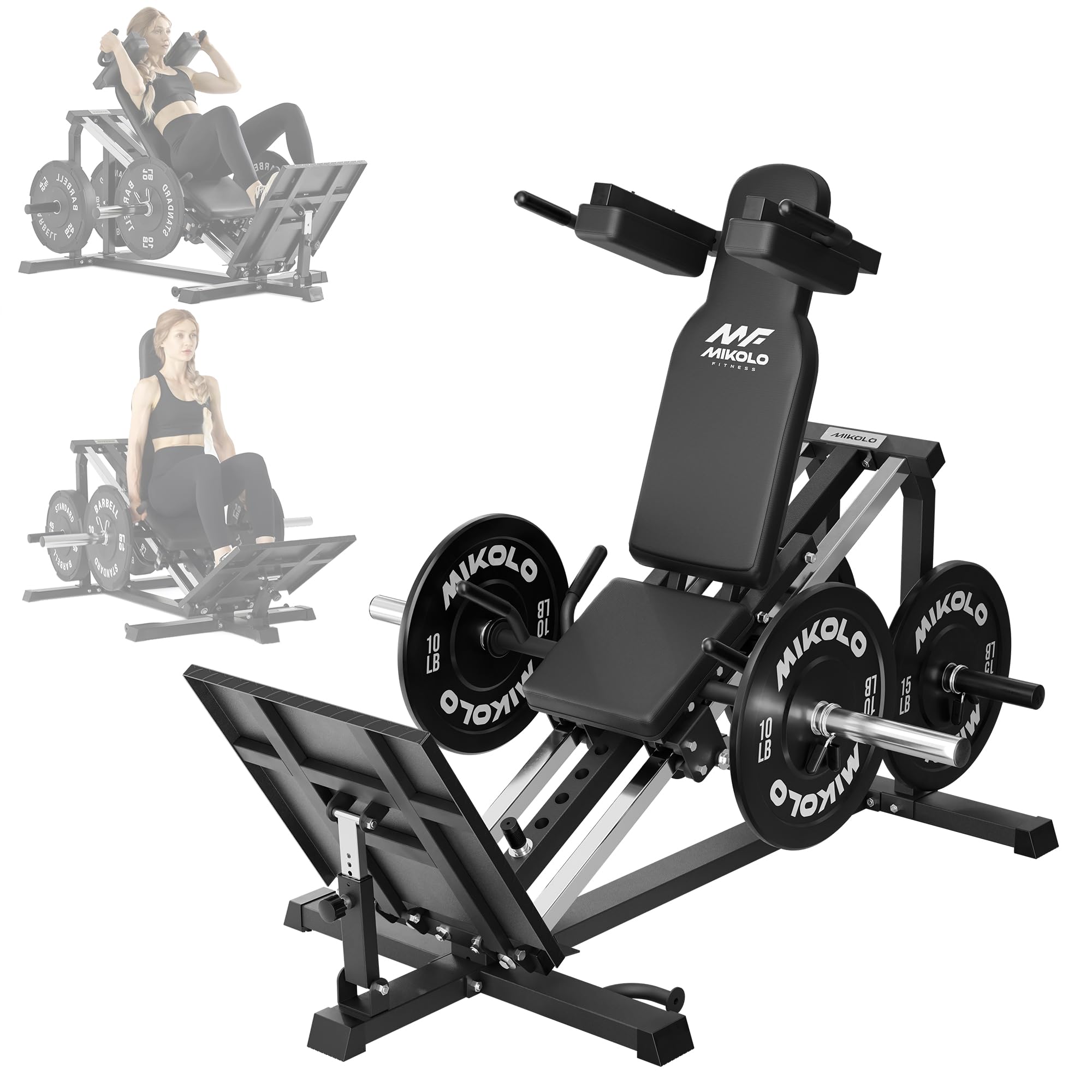
Mikolo LP05 45-Degree Leg Press

Mikolo LP05 45-Degree Leg Press

Heavy loading

Our Score 9.2/10
Check Price

Worth Noting

  • 88-inch depth needs a long clear wall
  • Leg press only, with no hack squat mode
Max Load
2,000 lb
Band Pegs
Four
Footprint
88"D x 26"W x 55"H
Machine Weight
220 lb
Read the full review

Twenty-six inches of width is what makes the LP05 worth a look, and 88 inches of depth is what you pay for it. Laid along a wall it takes less floor than any other plate-loaded machine here, including its own 30-degree sibling, but it needs a long wall to do it. In a narrow garage bay or down the side of a corridor, that's a good trade. In a shallow box room it isn't, and no clever rearranging fixes it.

What the length buys is the heaviest machine in this guide: 220 pounds of 11-gauge steel rated to 2,000 pounds, linear bearings on the carriage, and four band pegs for adding resistance without another pair of plates. We were surprised by how little it moved under load — a light frame walks and rattles across a garage floor, and this one plants. It's a leg press only, though: no shoulder pad, no hack squat, no switching between the two. If you want two movements from one footprint, this isn't the machine you're shopping for.

The details are the ones you notice training alone. Three start heights on the rotating safety handle let you set the carriage with your feet already on the plate, and the dual grips give you something to hold on the way out. Two boxes arrive with hardware and tools, one person can build it over a couple of hours, and the warranty runs two years.

Bottom line: If your wall is long and your plates are heavy, this is the machine: the most stable sled here, as long as you can give it 88 inches of run.

#3

Mikolo LP10 Leg Press Hack Squat

Mikolo LP10 Leg Press Hack Squat

Small home gyms

Our Score 9.0/10
Check Price

Worth Noting

  • 52-inch width needs a wide wall or corner
Max Load
1,000 lb
Footprint
67"D x 52"W x 47"H
Sled Angle
30 degrees
Machine Weight
165 lb
Read the full review

Thirty degrees is the whole trick. Instead of copying the 45-degree sled almost everyone sells, Mikolo stood the LP10 up steeper, which pulls the machine in front to back — 67 inches deep against 70 on the Goimu, 77 on the Mdeam and 88 on Mikolo's own LP05. If your gym is a corner of a garage with a water heater in it, that difference is the entire argument.

The angle changes the movement, and that's worth knowing before you commit. A sled this steep doesn't feel like the 45-degree press at your old gym; the load sits differently through the middle of the rep, and we wanted a couple of sessions before we trusted our depth on it. What the trade buys you is two movements in one footprint: the shoulder pad comes off for leg press work and goes back on for hack squats, with seven backrest and seven footplate angles to work from.

Assembly is the part we brace for with these machines, and the LP10 was the least painful build of the sleds here — one person, tools in the box, two years of warranty at the end of it. Shorter lifters should know the hack squat pads sit high: at 5 foot 5 they can land a few inches above the shoulders, and a folded towel closes that gap. The 1,000-pound rating is more ceiling than most garages will ever reach.

Bottom line: For a room that has to do everything else too, the LP10 is the one to beat: a 30-degree combo that shortens the footprint without turning leg day into a compromise.

#4

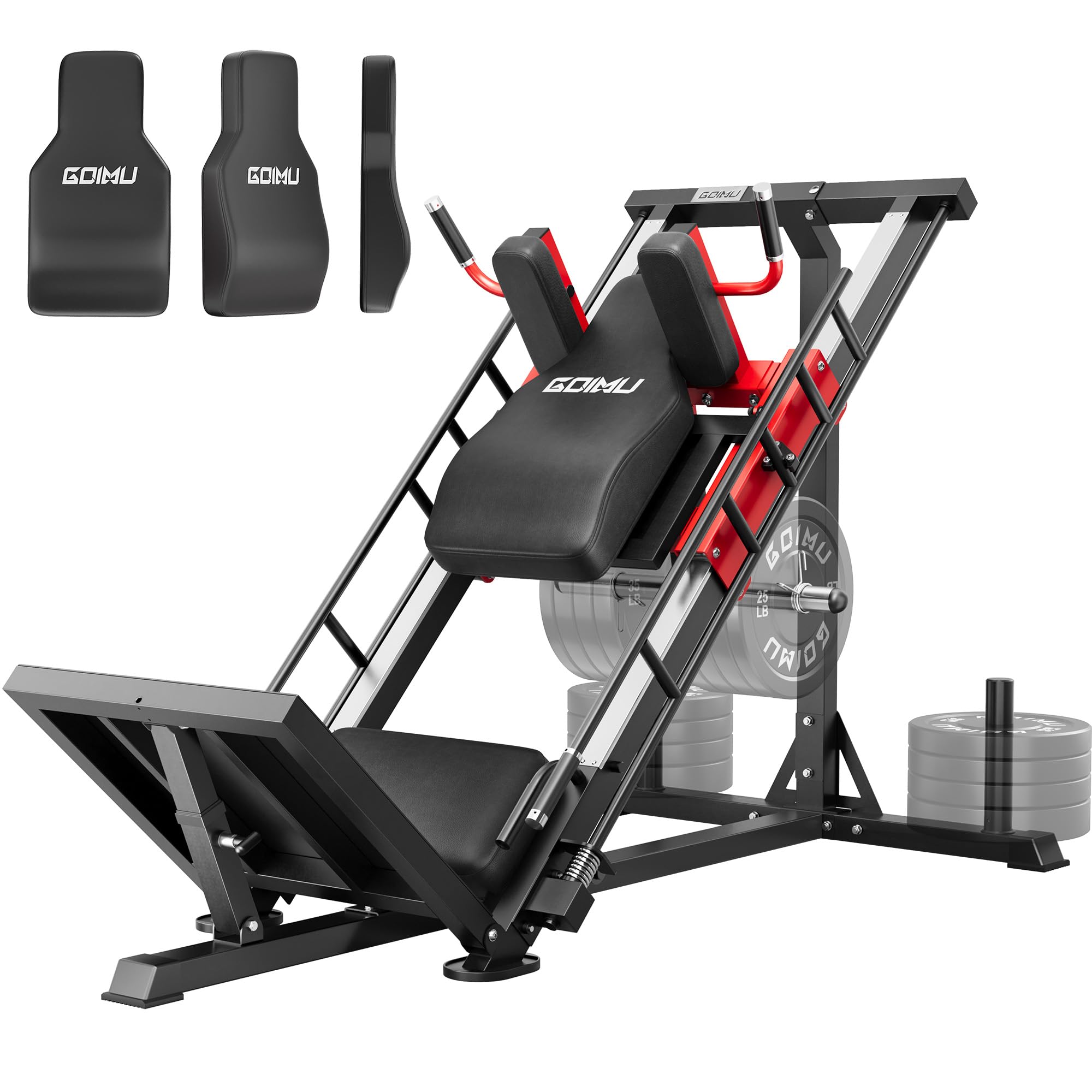
Goimu Leg Press Hack Squat Machine

Goimu Leg Press Hack Squat Machine

Adjustable setup

Our Score 8.6/10
Check Price

Worth Noting

  • No manufacturer warranty stated
  • Picture-only instructions and an awkward solo build
Max Load
1,200 lb
Warranty
None stated
Footprint
70"D x 42"W x 55.5"H
Sled Adjustments
5 hack squat, 3 leg press
Read the full review

Depth is the question to settle first with the Goimu. The platform runs on fixed stoppers, and they sit high enough that a lifter around 5 foot 8 can come up short of the deep stretch a hack squat is for. That's a fit issue rather than a defect, but it isn't one a wrench fixes, so ask where the stops land relative to your height before you order.

Everything around that is more accommodating. Five hack squat angles and three leg press settings is the widest adjustment range in this group, the diamond-plated footplate holds a sweaty shoe, and the 70-by-42-inch frame splits the difference between the wide Mikolo and the long, narrow LP05. Rated to 1,200 pounds with 2-inch plate sleeves, it leaves most home lifters room to keep adding weight for a long while.

The parts we minded are the paperwork and the backing. Assembly is the most divisive of any machine here — some builds go up solo, others want a second pair of hands for the carriage — and the instructions are pictures with almost no words. There's also no manufacturer warranty stated, which on a machine this heavy is the reassurance we want most. We think it's a solid buy for a handy lifter with average depth needs; go in knowing you're on your own if something arrives wrong.

Bottom line: A well-built, widely adjustable combo that suits handy lifters of average height — check the depth stops and the missing warranty before you commit.

#5

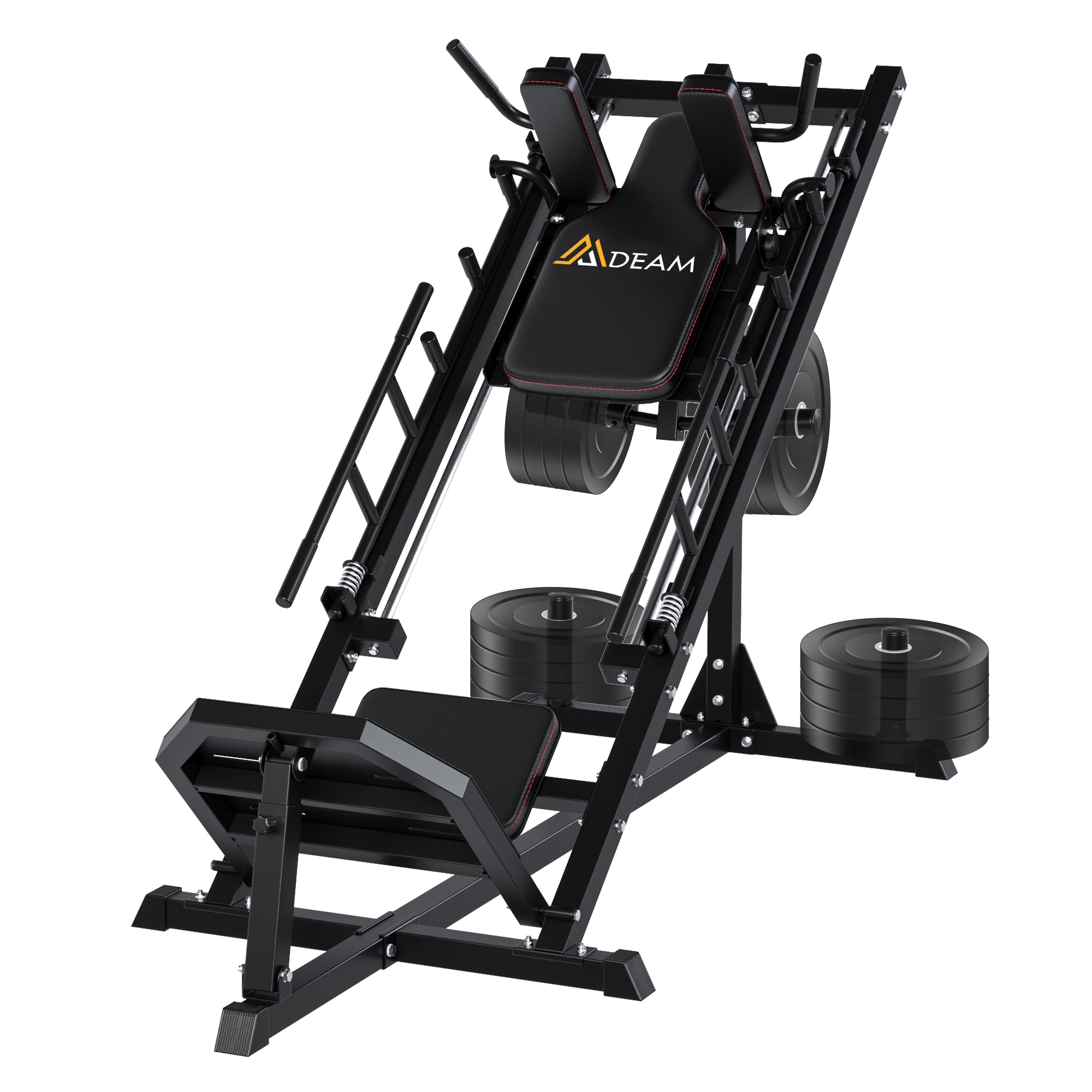
Mdeam Leg Press Hack Squat Machine

Mdeam Leg Press Hack Squat Machine

Quiet operation

Our Score 8.4/10
Check Price

Worth Noting

  • Second-longest footprint here, at 77 inches
  • Sled has no bumpers and knocks the base
Bearings
Linear
Max Load
1,400 lb
Footprint
77.1"D x 36.4"W x 52.3"H
Machine Weight
142.4 lb
Read the full review

Fourteen hundred pounds is the biggest plate-loading claim here after the LP05, and the hardware behind it deserves a harder look than the headline gets. In leg press mode the whole load runs through a single locking pin, and the horns take a few plates a side rather than a stack of 45s. Treat 1,400 as the frame's ceiling, not your working weight — fine for a home gym, as long as you know the number on the box isn't the number you'll train with.

The carriage itself is the quiet one of the group. Linear bearings rather than rollers give it an even, low-noise glide, and at 64.6 kg the frame is light enough for two people to shift once it's built. It's also 77 inches deep, second only to the LP05 here, so measure twice before you fall for the quiet.

Comfort is better than the rest of the package suggests: thick shoulder and back cushions under a wear-resistant cover, and a diamond-plated footplate. Hack squats take some arranging — you thread in under the pads rather than step in — and the warranty runs a single year where most of the sleds here give two. Neither is a dealbreaker; both are things you notice in week two rather than day one.

Bottom line: A quiet, comfortable sled whose load rating is worth taking with salt — a good second choice if the 77-inch footprint fits your room.

#6

PASYOU PM35 Leg Press Bench

PASYOU PM35 Leg Press Bench

Tight spaces

Our Score 8.2/10
Check Price

Worth Noting

  • Not plate-loaded
  • Narrow base feels less planted under heavy pressing
Footprint
65.55"D x 22.63"W x 46.65"H
Resistance
12 hydraulic levels
Machine Weight
57 lb
Backrest Angles
9
Read the full review

The PASYOU isn't a sled, and that's the first thing to be clear about. It's a folding adjustable bench with a leg extension and curl attachment, and its resistance comes from twelve hydraulic levels rather than plates on a carriage. It suits one reader: someone in a small apartment who wants leg training and general bench work from a single 57-pound object that tucks into a corner. If you want to add five pounds a week to a leg press, it will frustrate you.

As a bench it's more useful than the leg station suggests. Nine backrest angles cover chest, shoulders, arms and core, there's a dumbbell rack on the frame, and the 1,300-pound structural rating means a pair of loaded dumbbells won't fold it. The hydraulic press works quads, glutes, hamstrings and calves; what it can't do is load progressively the way a plate sled does, so it suits higher-rep sets better than a heavy strength block.

Two things to accept before you order. The narrow base that lets it disappear into a closet is also what makes a heavy press feel less planted than a full-width bench. And the instructions are small and easy to misread; the assembly video on the product page does the job better. Neither changes what it is: the smallest and least expensive way into leg training here, and the one that asks least of your room.

Bottom line: We think it earns its corner in a small apartment: a folding bench with a hydraulic leg station, not a substitute for a plate-loaded leg press.

How We Tested Seven Compact Leg Presses

We started by gathering every compact leg press we could find from the major home gym brands — about 30 models — then cut the list by footprint, plate compatibility, whether the frame carried a stated weight rating, and what actually came in the box. That left seven machines, which we assembled in home gyms, basements, and one very patient garage, and lived with for six months of weekly sessions.

Assembly came first, because it's where these machines lose people. We timed each build solo with a stopwatch, then again with a second person to see how much of the manual quietly assumes help. We noted whether hardware arrived bagged by step or in one anonymous pile, how many steps hinged on a single murky diagram, and whether the instructions bothered to explain the platform adjustment at all.

Then we loaded them. Each press got moderate-weight sets and sets near its rated capacity — leg press, calf raises, and the slow negatives that expose flex in a frame. We watched the feet to see if they stayed flat on concrete or dug into carpet, and whether the unit rocked or crept forward when we drove through our heels. We also kept an eye on welds, coating, and how much play worked into the sled track after a few weeks of use.

Adjustability got its own pass: two testers, one at 5'4" and one at 6'2", ran identical sessions on every machine and noted whether changing the back pad or platform took one hand, two hands, or a wrench. We rolled each press across a garage floor and through a standard doorway to find out what the wheels were good for, and we judged value honestly — what's included, what you must buy separately, and whether the frame felt built to outlast its warranty.

How to Choose

Measure the wall run, not the footprint

Floor area is the wrong thing to compare first. A sled is a long object with a plate carriage on it, and what actually crowds a room is the wall run it needs plus the space to stand, load plates and step out. A 26-inch-wide machine that runs 88 inches along a wall and a 52-inch-wide machine that only reaches 67 inches into the room can cover similar floor and still only one of them will fit your garage.

So measure the longest clear wall you have, then the depth in front of it, then add room to walk around the plate horns. The word compact in a product title describes the frame, not the clearance you actually work in.

The angle changes the machine and the movement

Most home sleds run at 45 degrees, because that's what commercial leg presses are and what most people have trained on. A 30-degree machine stands up steeper, which shortens how far the frame reaches into the room. The trade is a press that feels different through the middle of the rep, with the resistance arriving earlier than it does on a 45.

Neither angle is better. If you've spent years on a 45-degree sled, expect a few sessions to recalibrate before you load it heavily, and pick the angle your room will tolerate rather than the one you're used to.

Leg press only, or press plus hack squat

A combo adds a shoulder pad and an adjustable back pad for hack squats, so one footprint covers two movements — the pattern most of the machines here follow. A dedicated leg press puts the same money into the carriage, the bearings and the load rating instead.

If your program already has a squat variation you're happy with, the dedicated machine is the better use of floor space. If it doesn't, the combo earns its place, because a second machine is the one thing a small gym can't absorb.

What a load rating actually covers

Every machine here quotes a plate capacity, and none of those numbers is the weight you'll train with. The rating describes what the frame is built to survive; what you can actually load is set by the plate horns — often a handful of plates a side — and by how the carriage takes the strain in leg press mode. On one machine here, the entire press load runs through a single locking pin.

Treat capacity as a way to compare frames, not as a promise about your training weight, and check how many plates the horns will physically hold before you plan a heavy block.

Rails, catches and the build itself

Sled feel comes down to bearings. Linear and ball-bearing carriages glide quietly and evenly; roller systems are noisier and can bind under a heavy, uneven load. Then look for a safety catch you can set from the working position and stops that keep the carriage off the base at the bottom — a metal-on-metal knock at the end of every rep is the kind of thing that annoys you for years.

Plan the build, too. These ship in two boxes, some weigh well over 200 pounds assembled, and a couple of hours with one person is normal. Where the instructions are pictures only, the product page video is usually better than the manual.

Frequently Asked Questions

Final Verdict

The Mikolo LP10 is our default here: 67 inches of depth, a 30-degree sled, and a hack squat mode that costs no extra floor. It's the machine that fits the room most people actually have.

If your wall is long and your plates are heavy, the LP05 is the better buy — 26 inches wide, rated to 2,000 pounds, and the most planted sled in the group. Measure the wall first; that single number chooses between them more often than anything else.