Strength & Weights

Best Adjustable Kettlebells of 2026

A rack of kettlebells is a beautiful thing until you have to find a home for eight of them — and pay for eight of them. An adjustable kettlebell solves both problems: one bell, one footprint, a range of weights for the price of two or three fixed ones. The catch is that the good ones have to feel like a real kettlebell, not a stack of plates rattling on a handle. That's the question I kept coming back to.

Over the past six months, my team and I have put 12 adjustable kettlebells through swings, cleans, presses, and goblet squats in garages, basements, and living rooms. We weighed every setting on a scale, timed how long each changeover took with sweaty hands, and paid attention to the things you only notice after a few weeks — handle thickness, plate shift, finish wear. The best ones disappear into the workout. The rest are in the list below, sorted by what they do well and who they're for.

#1

BowFlex SelectTech 840

Top Pick
BowFlex SelectTech 840

Full home gyms

Our Score 9.6/10
Check Price

Worth Noting

  • No fine jumps between 12 and 20 lb
  • Composite shell is not built to be dropped
Material
Composite
Warranty
2 years
Handle Diameter
28 mm
Weight Settings
8, 12, 20, 25, 35, 40 lb
Read the full review

Six bells' worth of weight in one footprint is the promise, and the SelectTech 840 keeps it. A dial at the top of the shell selects 8, 12, 20, 25, 35, or 40 pounds, and changing it is one turn rather than a walk to the rack. That is why it's our top pick: in a small room, the difference between one bell by the door and six on a stand is the difference between training at home and not training at all.

The settings are the compromise. 8, 12, 20, 25, 35, 40 is not an even ladder, and the jump from 12 to 20 pounds is the biggest single step in the set — right where a lot of pressing and rowing happens. If your program moves in five-pound increments, plan on spending longer at one setting, or on pressing 20 pounds before you feel ready for it. We noticed this most on overhead work, where two pounds either way changes how many reps you get.

It's also a bulky object for a kettlebell. The shell is taller and wider than a cast-iron bell of the same weight, and the hard plastic edge makes itself known against the forearm in a rack position. Swings, goblet squats, rows, and presses all felt fine to us. Anything that asks the bell to pass under a leg or swing around the body is where the shape gets in the way, and shorter lifters hit it first. The 28 mm handle is on the slim side, which is a gift for smaller hands and for a two-hand grip.

What settled it was how little thought the thing needs: pick it up, dial, train, put it down. The plastic handle and composite body are not built to be dropped or slammed, so it wants a mat and a deliberate set-down — a fair request for something that replaces a rack you'd otherwise trip over.

Bottom line: We recommend it as the default adjustable kettlebell: 8 to 40 pounds on a dial, one footprint, and a shape that suits swings and squats far more than under-the-leg work.

#2

Polyfit Adjustable Kettlebell

Polyfit Adjustable Kettlebell

Learning the basics

Our Score 9.6/10
Check Price

Worth Noting

  • 12 lb top weight runs out fast
Material
Polyethylene
Handle Diameter
30–38 mm
Weight Settings
5, 8, 12 lb
Read the full review

If you're starting from nothing, a 40-pound bell is a heavy ornament on the floor. Polyfit's 5-8-12 pound kettlebell takes the opposite approach: three light settings in one small shell, changed by turning the top handle rather than loading plates.

The load comes from segments that click in as you rotate the handle, the shell is covered in a non-slip PE coating, and the handle measures roughly 30 to 38 mm — sized for a smaller hand rather than a gym mitt. At 12 pounds it won't build a deadlift, but for goblet squats, rows, halos, and learning a swing pattern it's the right amount of weight for the first few months, and the whole thing is light enough to move between rooms or take on a trip.

We like it best as a starter and a spare rather than a permanent bell. Two things define it. The first is the mechanism: the segments don't always release cleanly, and there's a knack to seating the handle so a section doesn't reattach when you didn't ask it to — press it home and check the setting has locked before each set, and it behaves. The second is the ceiling. Twelve pounds runs out quickly if you're already training, so treat this as a first bell rather than an only bell.

It's also a genuinely useful second bell for a home with one heavier adjustable: keep it loaded at 8 or 12 pounds for warm-up sets and for anyone else in the house who wants to join in without touching your working weight.

Bottom line: Our starter pick: three light settings and a comfortable small-hand grip for a first season of training, with a mechanism worth checking before every set.

#3

Yes4All Adjustable Kettlebell

Yes4All Adjustable Kettlebell

Fine weight jumps

Our Score 9.2/10
Check Price

Worth Noting

  • Plate changes are slower than a dial
  • Nominal settings can run slightly off
Material
Cast iron
Warranty
1 year
Handle Diameter
1.2 in
Weight Settings
7.8, 12.4, 17.9, 23.9, 29.9, 35.4, 40 lb
Read the full review

Seven settings — 7.8, 12.4, 17.9, 23.9, 29.9, 35.4, and 40 pounds — come from a stack of cast-iron plates you add and lock by hand. Nothing is hidden inside a shell, which is the whole appeal: you can see what you're about to lift, and the discs are machined so the stack forms a rounded bell rather than a tower of plates.

We think that visible, mechanical honesty is worth more than it sounds. There's no dial to trust and no composite to wonder about, and the progression is the finest in this group — no single jump is bigger than six pounds, so a program written in five-pound steps almost lines up. Almost. The numbers aren't round (7.8, 12.4, 17.9), so log the setting you actually used rather than the round number you meant to use.

The trade is speed. Sliding plates on and off takes longer than turning a dial, and keeping up with a fast circuit takes practice; if you alternate weights every set, this will slow you down. One thing to check early: the plates aren't always exactly the weight stamped on them, and the assembled total can run slightly off the nominal figure. It's small enough to ignore mid-workout, but weigh the bell once on a bathroom scale and train off the real number if you track load closely.

The 1.2-inch handle is wide enough for two hands, and the flat base stands the bell upright between sets, which matters more than it sounds once you're on the floor for a press. A one-year warranty and a price well below the dial-based bells here make this the sensible second look for anyone whose program is built on swings, squats, and presses rather than fast circuits.

Bottom line: Our value pick: seven cast-iron settings with the tightest progression here, for anyone who'd rather load real plates than trust a plastic dial.

#4

Rep Fitness Adjustable Kettlebell

Rep Fitness Adjustable Kettlebell

Heavy swing work

Our Score 9.2/10
Check Price

Worth Noting

  • Highest price in this group
  • Internal plates shift slightly in the shell
Material
Iron
Adjustment
Push-and-turn dial
Top Weight
40 lb
Handle Diameter
1.3 in
Read the full review

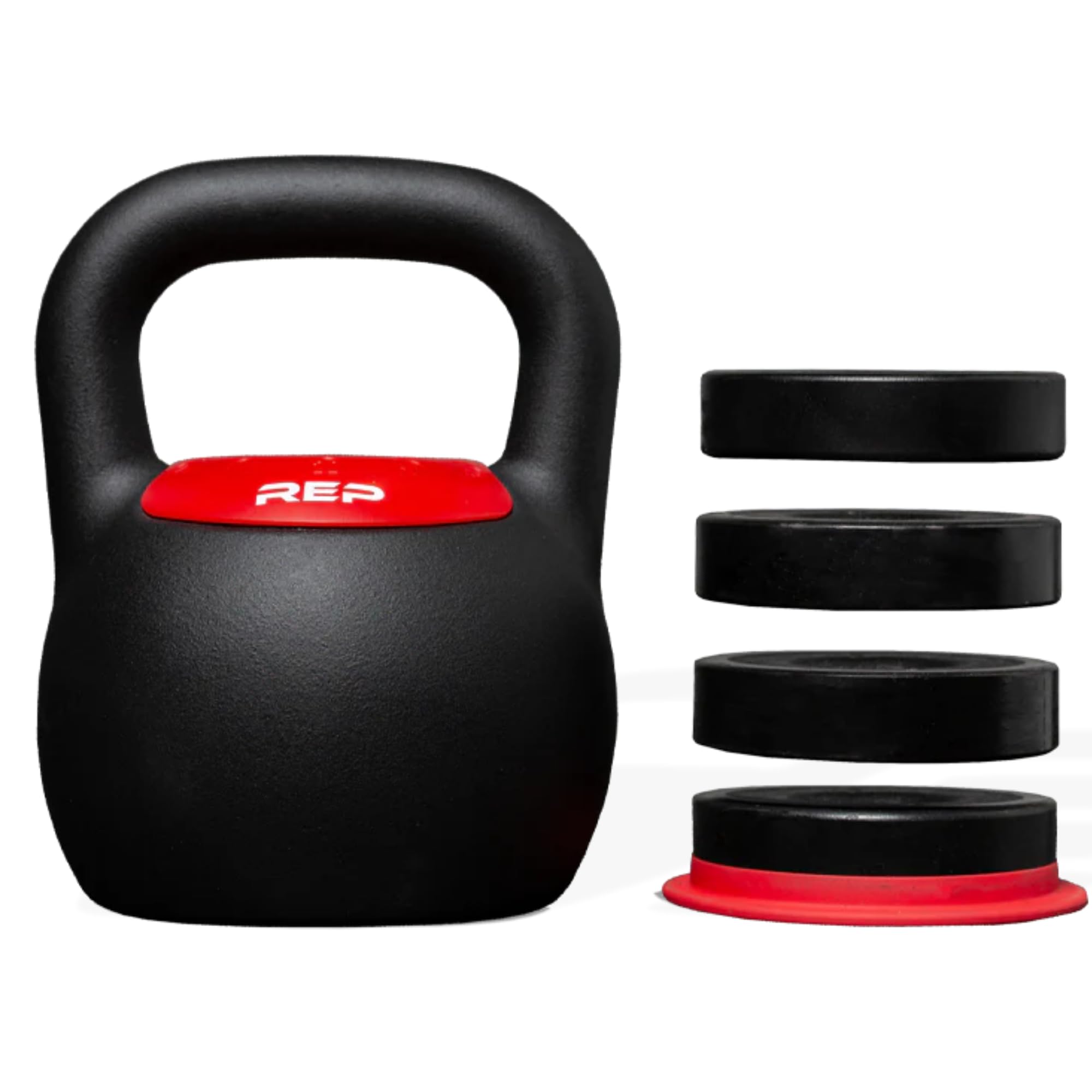
The Rep 40-pound bell costs the most here, and the money goes into the parts you actually grip: an iron body with a matte powdercoat that stays put in sweaty hands, a wide 1.3-inch handle, and a push-down-and-twist dial. That one-handed adjustment is the detail we kept coming back to — the load changes with the bell still in your other hand, so a working set doesn't dissolve into a trip to the shelf.

The finish is the other thing we noticed. Matte powdercoat isn't a cosmetic choice on a kettlebell; a glossy shell turns slick the moment your palms do, and this one keeps its bite through a long swing set. The iron body also doesn't mind being set down on concrete or a garage floor, which is not something we can say for the composite bells in this group.

Inside, the weights are held by nylon thermoplastic retainers, and there's a slight shift from the plates when the bell is moving fast. It never changed a swing for us, but it is the reason this is a floor bell, not one to drop. The one thing to confirm before ordering is what the intermediate settings are on the 40-pound model — the top weight is clear, the steps between it less so, and if your program needs specific jumps you'll want that pinned down first.

Bottom line: Our pick for heavy swing and press work: iron, a 1.3-inch handle and a dial you can work one-handed, at the highest price in this group.

#5

kure.fit Adjustable Kettlebell

kure.fit Adjustable Kettlebell

Small-space workouts

Our Score 9.2/10
Check Price

Worth Noting

  • 12 lb ceiling limits long-term use
Height
12.2 in
Material
PE shell, sand core
Handle Diameter
1.18 in
Weight Settings
5, 8, 12 lb
Read the full review

The kure.fit bell comes in sage with tonal shading across its sections, and each section is marked with the weight it holds, so you can see at a glance whether you're looking at 5, 8, or 12 pounds. That sounds like a small thing until a black cast-iron bell has been in the corner of a bedroom for a year.

What we appreciated most is that it doesn't look like gym equipment, and we're comfortable with that being the reason it earns a place. A weight light enough to live in a living room is one you'll actually pick up, and this is the only bell here designed with that in mind. The change is a press-and-twist rather than a dial: push the spring clasp, turn counterclockwise, seat the section. Once set, it holds.

Underneath, it's a PE shell over a sand-based composite core, 12.2 inches tall with a footprint around eight inches square, and a 1.18-inch handle wide enough for two hands. That's beginner territory, the same as the Polyfit, and its flat base and compact size suit an apartment or a shared room. The adjustment is the part that takes getting used to — the clasp needs a firm press and the sections can be stiff when new, so a change mid-set costs more than it does on a dial. Set the weight before you pick it up, not while it's swinging.

Bottom line: Worth it if the bell has to live in the room with you: a sage finish, weights marked on every section, and three light settings that stop at 12 pounds.

How We Tested Adjustable Kettlebells

We started by pulling together every adjustable kettlebell we could find from established strength brands and smaller outfits alike, then filtered the list by weight range, adjustment mechanism, footprint, and price. We cut anything with a history of stripped threads, vague weight claims, or a handle that looked like it would chew up your hands. That left 12 models, which we bought at retail so no brand could send us a hand-picked sample.

Testing ran for six months, mostly in a garage gym and a basement corner, with a few weeks in a living room to see how each bell behaved when space was tight. We swung, cleaned, pressed, rowed, and ran through Turkish get-ups with every model at its lightest, heaviest, and a middle setting. We weighed each setting on a digital scale to see how close it came to the number stamped on the side, and we noted whether plates shifted or rattled mid-swing.

Weight changes got their own test: we timed how long it took to go from one setting to another, first with dry hands and then after a set of swings, and we paid attention to whether the mechanism felt foolproof or fiddly. We also checked handle diameter and texture against the width of our hands, looked for hot spots during long sets, and inspected the finish and seams after weeks of use. Value came down to cost per pound of range and whether the bell still felt solid at its heaviest setting.

How to Choose Adjustable Kettlebells

Look at the steps, not just the range

A 5-to-40-pound range reads like a complete gym, but the jumps between settings decide whether you can progress. The BowFlex 840 goes 8, 12, 20, 25, 35, 40, and that 12-to-20 gap sits right where a lot of pressing and rowing happens, so you may spend weeks at a weight that's slightly wrong in one direction or the other. The Yes4All splits the same territory into seven steps, which is easier to grow through but hands you odd numbers to log.

Before you buy, write down your current working weight for a swing, a press, and a goblet squat, then check that each one exists as a setting. If two of the three fall into a gap, you'll feel it every session.

Where bulk actually bites

Every adjustable bell is bigger than a fixed bell of the same weight, because the shell has to hold plates plus a mechanism, and the extra height and width show up in specific movements. Swings, goblet squats, rows, presses, and deadlifts don't care. Cleans, snatches, and anything that passes the bell under a leg or around the body do: the shell crowds the forearm in the rack position and clips the thigh on the way through.

If those lifts are the point of your training, keep one fixed bell for them and let the adjustable handle the rest of the week. If they aren't, buy the adjustable and stop worrying about it.

Dial, plate stack, or twist clasp

Three mechanisms cover this category, and the choice comes down to how often you change weight mid-session. A dial moves in seconds and keeps every part inside the shell, which is why it suits circuits and drop sets; what you give up is being able to see what you're lifting. A cast-iron plate stack is slower and visible, and you can read the stamp on every disc, which is the cheaper route to a wide range.

The twist clasps on light 5-to-12-pound bells are the fiddliest of the three. They hold once seated, but budget some patience while the sections wear in.

Handle diameter and hand size

Handles here run from 28 mm on the BowFlex to 1.3 inches on the Rep, and you feel that difference late in a set. Thicker handles fill the palm and hold up better to heavy two-handed swings, but they tax grip endurance sooner and can be too much for smaller hands. Thinner ones are easier to hook and to hold overhead, and they leave room for overlapping fingers in a two-hand grip.

Finish matters as much as diameter. A matte powdercoat keeps its bite when your hands are sweaty; a gloss or bare plastic shell gets slick right when you need it not to.

One bell against a rack

The arithmetic that sells this category isn't complicated: one adjustable bell costs more than a single fixed bell and considerably less than the six or seven it replaces, and it takes a corner instead of a wall. What you pay in return is a little speed, a bulkier object, and a mechanism that needs locking properly rather than being indestructible.

For a home setup where the weights live in a room you also use, that's a trade most people should take. If you only ever train one weight, buy that weight fixed and skip the mechanism entirely.

Frequently Asked Questions

Final Verdict

The BowFlex SelectTech 840 is the adjustable kettlebell we recommend first, because 8 to 40 pounds on a dial covers a full home program in one object you can put in a closet at the end of it. Its real compromise is the gap from 12 to 20 pounds; if your training lives inside that range, the Yes4All's seven cast-iron settings step through it more gently for less money.

Rep's 40-pound bell is the one to pick if you want iron in your hands and a handle that fills them. Buy that one for heavy swing and press work, and buy the BowFlex if you want to stop thinking about how many bells you own.