Cardio Machines

Best Treadmills for Seniors of 2026

A treadmill can feel like a safe way to keep walking through winter—until you step onto a deck that flexes or grab a handrail that wobbles. For older walkers, the difference between a treadmill that gets used and one that becomes a clothes rack often comes down to a few unglamorous details: a low step-up, a stable frame, controls you can read without leaning in, and a footprint that doesn't take over the room. The right model makes daily walking feel less like a balance test and more like a habit.

Over eight months, I tested seven treadmills built with older walkers in mind, from compact models to sturdier ones with incline. The best ones didn't have the longest feature lists; they were the ones that assembled without drama, stayed steady when I grabbed the rail, kept speed without surprises, fit the room, and felt worth their price. The picks below lean on those priorities.

#1

Redliro Walking Treadmill

Top Pick
Redliro Walking Treadmill

Everyday walking

Our Score 8.8/10
Check Price

Worth Noting

  • 16-inch belt leaves little room for arm swing
Deck Size
41 x 16 in.
Folded Size
51.2 x 27.4 x 9.4 in.
Speed Range
0.3–5.5 MPH
Weight Capacity
300 lb
Read the full review

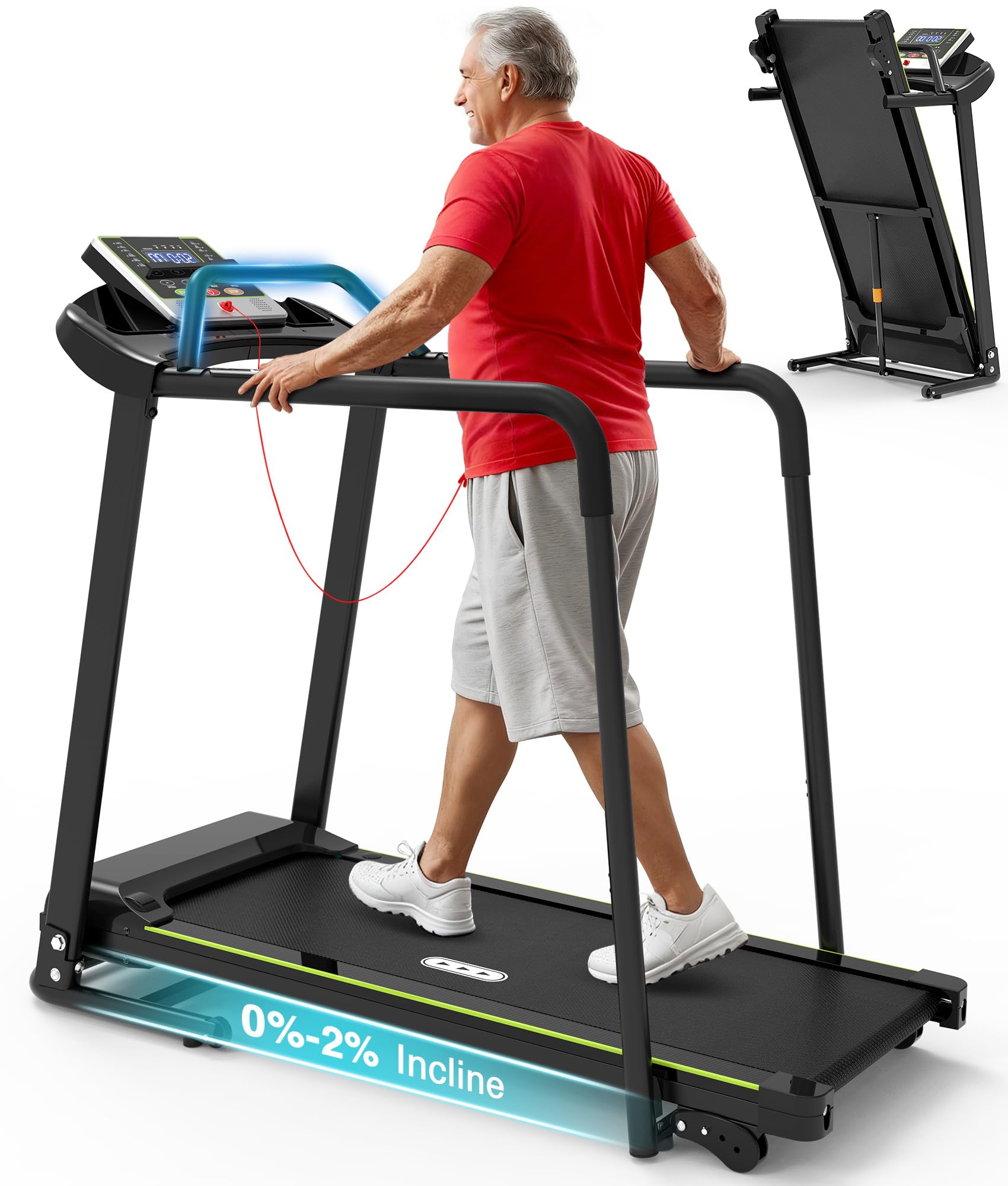
A treadmill that starts at 0.3 MPH changes what getting on feels like. You can stand with both feet planted, clip the safety key on, and let the belt creep while you find your rhythm instead of chasing it. That low start is the number we care about most in this category, and the Redliro pairs it with the most complete set of rails here: long side rails plus a front bar for both hands, with the backlit console sitting between them. It also climbs to 5.5 MPH, so the same machine works for a spouse taking a brisk walk.

Nothing about it feels like gym equipment. At 79 pounds with wheels up front, one person can push it into a corner, and the handrails unbolt if someone else in the house wants the deck clear. We also appreciated the auto-lubrication, which takes the recurring belt-oiling chore off the list — one less thing to remember on a machine that lives in a spare room.

Folding asks for more patience than the marketing suggests. The deck does drop to a 9.4-inch profile and rolls away, but you take the handrails off with tools to get there, so it's a job for storage rather than a nightly routine. Plan on leaving it set up, which is how a treadmill gets used anyway; the flat fold is really there to make delivery and the occasional move easier.

Bottom line: The most reassuring treadmill here to step onto and stay on: it starts at a crawl, gives you rails on three sides, and still folds away. We recommend it for any senior who wants to walk daily at home.

#2

Exerpeutic Senior Fitness Treadmill

Exerpeutic Senior Fitness Treadmill

Heavier walkers

Our Score 8.8/10
Check Price

Worth Noting

  • 53-inch depth is the longest footprint here
Warranty
2 years limited
Deck Size
53 x 23 in.
Speed Range
0.3–4 MPH
Weight Capacity
400 lb
Read the full review

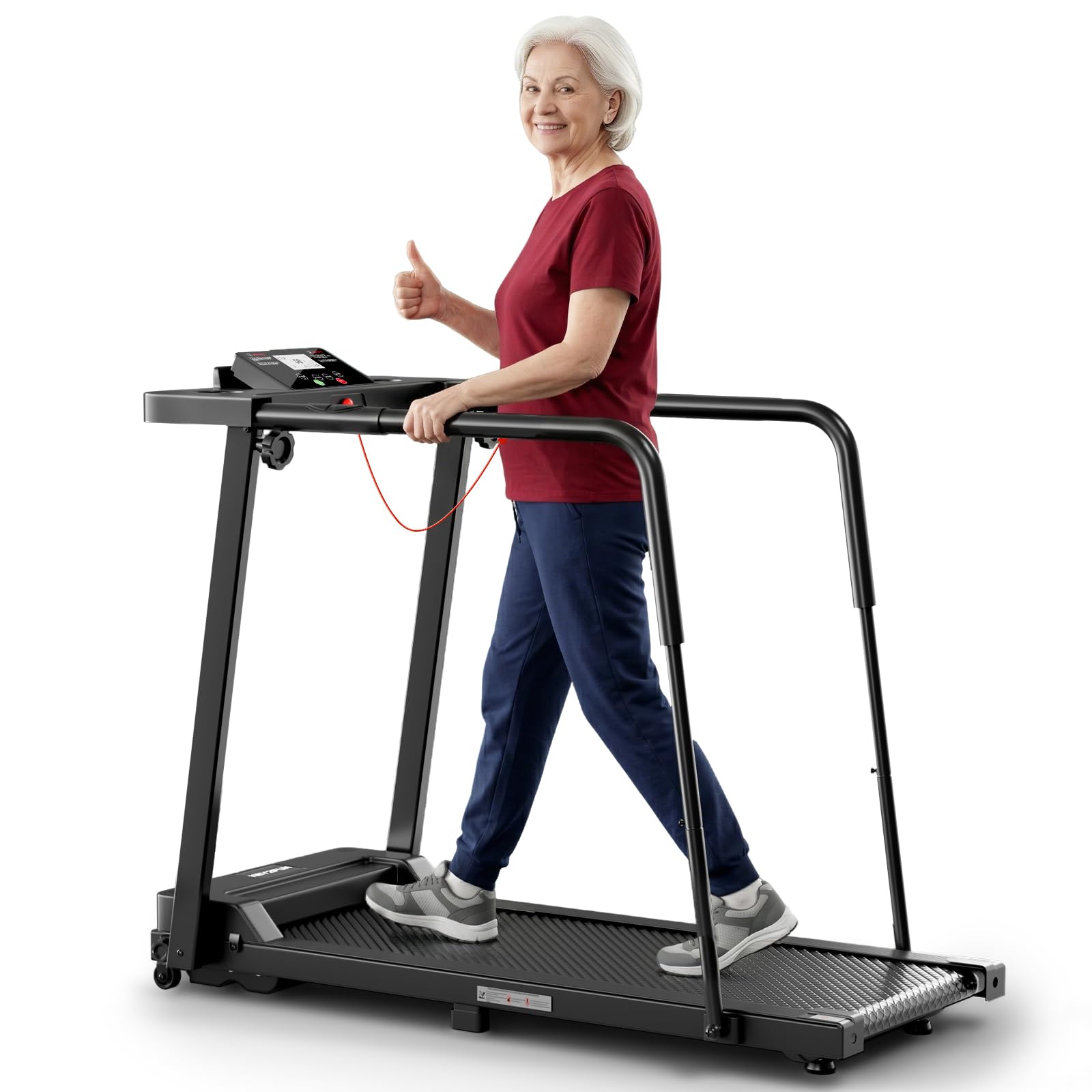
Four hundred pounds is the highest weight rating in this group, and it isn't the only reason the Exerpeutic earns a spot. The rails run the full length of the deck with foam padding that's comfortable to hold loosely rather than grip, the backlit console shows time, distance, calories, speed and pulse, and the step-up is low enough that getting on doesn't feel like climbing. For a heavier walker, or anyone who wants the most substantial machine on this list, this is the one.

The speed control is unusually fine. It starts at 0.3 MPH and moves in tenths of a mile per hour up to 4 MPH, so you can nudge your pace rather than jumping to the next setting. Six shock-absorbing cushions under the deck soften the footfall, and two pockets in the console give you somewhere to put a phone and a pair of glasses. It's also the only machine here covered for two years.

The 4 MPH ceiling is the trade-off, and it's why this isn't our overall pick. If a partner wants to jog while you walk, look at the FYC instead. The Exerpeutic is a walking machine from the deck up, and it's better for admitting that.

Bottom line: If the walker is near or over 300 pounds, this is the one we point to: a 400-pound frame, rails you can hold the whole way down the deck, and the longest warranty here.

#3

KEY2FUN Walking Treadmill

KEY2FUN Walking Treadmill

Small spaces

Our Score 8.8/10
Check Price

Worth Noting

  • Slowest setting is 0.6 MPH, not a crawl
Footprint
47.6 x 22.8 in.
Item Weight
58.5 lb
Speed Range
0.6–5 MPH
Weight Capacity
300 lb
Read the full review

This is the least expensive treadmill here with real handrails, and at 58.5 pounds it's also the lightest. That combination makes it the practical answer for a small apartment, a spare bedroom, or anyone who needs to shift the machine out of the way between walks. It reads as a useful treadmill at the entry end of the category rather than a stripped-down one.

You get more for the money than we expected: a 3.0 HP motor, twelve programs, a large LCD, and heart-rate sensors built into the handrails so you can check your pulse without a chest strap. Assembly is straightforward, with the tools and hardware in the box, and the phone and cup holders matter more than they sound — a treadmill with a water bottle within reach is one you stay on longer. The single compromise is the starting speed, which is quicker than the crawl our other picks offer.

At 47.6 by 22.8 inches, the frame is the narrowest of the five, which is exactly why it slides beside a couch or down a hallway where the bigger machines won't go. A one-year warranty covers it, worth knowing if it's going to be walked on several times a day.

Bottom line: The treadmill we suggest when the budget is tight or the room is small: real handrails, the lightest frame here, and a motor that holds a steady walking pace.

#4

FYC Walking Treadmill

FYC Walking Treadmill

Shared households

Our Score 8.6/10
Check Price

Worth Noting

  • More top speed than a walking-only household needs
Footprint
50.5 x 26 in.
App Control
Bluetooth, Fit Show app
Speed Range
0–7.5 MPH
Weight Capacity
300 lb
Read the full review

A 7.5 MPH top speed looks out of place on a machine built around senior walking, and that's the point: this is the one here that can carry a household. One person walks at a slow, careful pace; another jogs. The extended handrails, the six-layer belt and the eight-spring deck are all aimed at the walker, and the extra speed doesn't cost anything in how the machine behaves at low pace.

The details are tuned for older eyes and older knees. The backlit display uses large, readable fonts, the deck is cushioned by eight springs under a six-layer belt, and the platform sits low enough that you step onto it rather than climb. The Fit Show app adds virtual routes — a forest path, a beach walk — over Bluetooth, which sounds like a gimmick until you've spent twenty minutes looking at a wall.

Where it gives ground to the Redliro is the slow end. For pure walking at home, we still point to the Redliro's 0.3 MPH floor and three-sided rails, because the FYC's advantage only matters if somebody else in the house will actually use the higher speeds. Buy it for the household, not for one walker.

Bottom line: Buy this one when the treadmill has to serve the whole house: senior-friendly rails and cushioning up front, with enough top speed for a jogger in the family.

#5

Krisrate Walking Pad Treadmill

Krisrate Walking Pad Treadmill

Adding incline

Our Score 8.6/10
Check Price

Worth Noting

  • 4 MPH ceiling rules out jogging
Control
Hand-held remote
Incline
5%
Top Speed
4 MPH
Weight Capacity
300 lb
Read the full review

Five percent doesn't sound like much until you're the one walking it. The Krisrate is the only treadmill here with an incline, and adding grade is the gentlest way to make a walk harder without making it faster — useful when your pace is fixed but your effort isn't. The incline is set on the foot pads at the base of the machine rather than from the console, so you choose it before you start and leave it for the session.

The hand-held remote is the feature we didn't expect to care about. Being able to change speed without reaching forward for a console is exactly the sort of thing that matters when your other hand is on a rail. The 2.5 HP brushless motor runs smoothly at walking pace, the LED display is bright and simple, and the extra-long handrail gives you something to hold the whole way.

Treat it as the specialist of the group rather than the default. If you want the incline and you like the idea of a remote, this is the only machine that offers either, and it does it at the low end of the price range. If your routine is a flat walk at a steady pace, the Redliro's fuller rails and slower start serve you better.

Bottom line: The one we suggest if you want to add effort without adding speed: it's the only pick here with an incline, and the remote keeps your hands where they belong.

How We Tested Treadmills for Older Walkers

I began with specs and owner feedback on more than two dozen treadmills, then narrowed the field to seven models that covered different needs: compact footprints for tight rooms, sturdier decks with incline, and controls that were easy to see and reach. Anything with a high step-up or a cluttered console was cut early. Over eight months, I used each treadmill for regular walks rather than quick test laps, so assembly, reliability, and daily livability had time to surface.

Assembly came first. I unboxed each one, timed the setup, and noted whether the instructions were clear enough to manage alone or whether the frame needed a second person. Then I put each treadmill where it would actually live—a basement, spare bedroom, living room corner—and walked before breakfast and after dinner, often in house shoes. I practiced stepping on and off with one hand on the rail, the way an older walker might.

During those walks, I checked whether the deck stayed stable when I shifted my weight, whether the handrails met my hands naturally, and whether speed and incline controls were readable without leaning down. I changed incline mid-walk to see if the deck stayed planted and the transition felt smooth. I logged console glitches, belt drift, and motor noise over repeated use, and measured each footprint with a chair or doorway nearby. For value, I compared what each machine included against what it asked me to spend.

How to Choose a Senior-Friendly Treadmill

Start with the rails, not the motor

Full-length side rails let you hold on at any point in your stride, not just at the front, and a front bar gives you something for both hands while you find your balance. The Redliro's three-sided setup and the Exerpeutic's foam-padded full rails are the strongest examples here; a single short bar asks more of your balance.

Check the reach as well as the height. You want to change speed without letting go, because the moment you need both hands on a console is the moment you don't have them free. Rail height is worth setting against your hip: a bar well below your waist turns a steadying grip into a bend.

The slowest speed matters more than the fastest

Every machine here goes fast enough for a purposeful march. What varies is how gently they start and how finely you can adjust: the Redliro and Exerpeutic both begin at 0.3 MPH, the KEY2FUN at 0.6, and that difference is a shuffle versus a stride for someone rebuilding strength. Look for speed changes in tenths of a mile per hour too, since a machine that jumps in half-mile steps lurches.

If you want more effort without more speed, an incline does that job. Only the Krisrate offers one in this group, and it is set down at the foot pads rather than from the console, which makes it a preset rather than a mid-walk adjustment.

Deck size, step-up height, and the compact trap

Compact in a treadmill listing describes the frame, not the belt. The Redliro's deck is 41 inches long and the Exerpeutic's is 53, and if you have a long stride that difference is where your foot lands. Width matters for the same reason: 16 inches leaves little room to swing your arms, while 23 inches lets you walk rather than shuffle.

Step-up height is the other half of getting on safely, and a low platform you can stand astride beats a high deck you have to climb. Measure your space, then check the footprint: these run roughly 40 to 53 inches deep and 22 to 26 inches wide.

Capacity, warranty, and belt care

Three hundred pounds covers most walkers here, and the Exerpeutic's 400-pound rating is the one to choose if you're near or over that line. It also carries the longest warranty in the group at two years, against one year on the Redliro, KEY2FUN and Krisrate. Horsepower is the number listings push hardest and it matters less at walking pace than a belt that runs smoothly.

Ask about belt care before you buy. Most machines need the belt lubricated on a schedule and ship with a tube of lubricant; the Redliro is the one here that handles it automatically. If a maintenance routine is the sort of thing that gets forgotten, that feature is worth choosing a machine for.

Frequently Asked Questions

Final Verdict

Most seniors should buy the Redliro. The three-sided rails and the 0.3 MPH start are the two things that decide whether a treadmill gets used every day, and it folds away without needing a dedicated room.

Choose the Exerpeutic if the walker is near or over 300 pounds, or if you want the longest rails and a two-year warranty. If a partner will jog on the same machine, the FYC's 7.5 MPH top end is the only reason to give up the Redliro's slower crawl.