Cardio Machines

Best Treadmills for Walking Seniors of 2026

A doctor says walk 30 minutes a day, and the first week goes fine — until the sidewalk ices over or the afternoon heat hits 95. That's usually when a treadmill enters the picture, not as gym equipment but as a handrail you can hold and a flat, predictable surface that's the same every morning. What a walker in their 70s or 80s needs from one is quiet, slow to start, easy to step onto, and boring in the best way.

We've spent nine months walking on seven treadmills in basements, spare bedrooms, and a second-floor condo, and the things that matter at 2 mph rarely show up on a spec sheet. Top speed and horsepower sell machines; what a walker feels is how gently the belt starts, whether the handrails are where their hands land, and how much the deck shifts underfoot. A treadmill that takes two people and an afternoon to assemble, or turns a spare room into an obstacle course, tends to stay folded against the wall. The picks below all stayed open.

#1

Yesoul Senior Treadmill

Top Pick
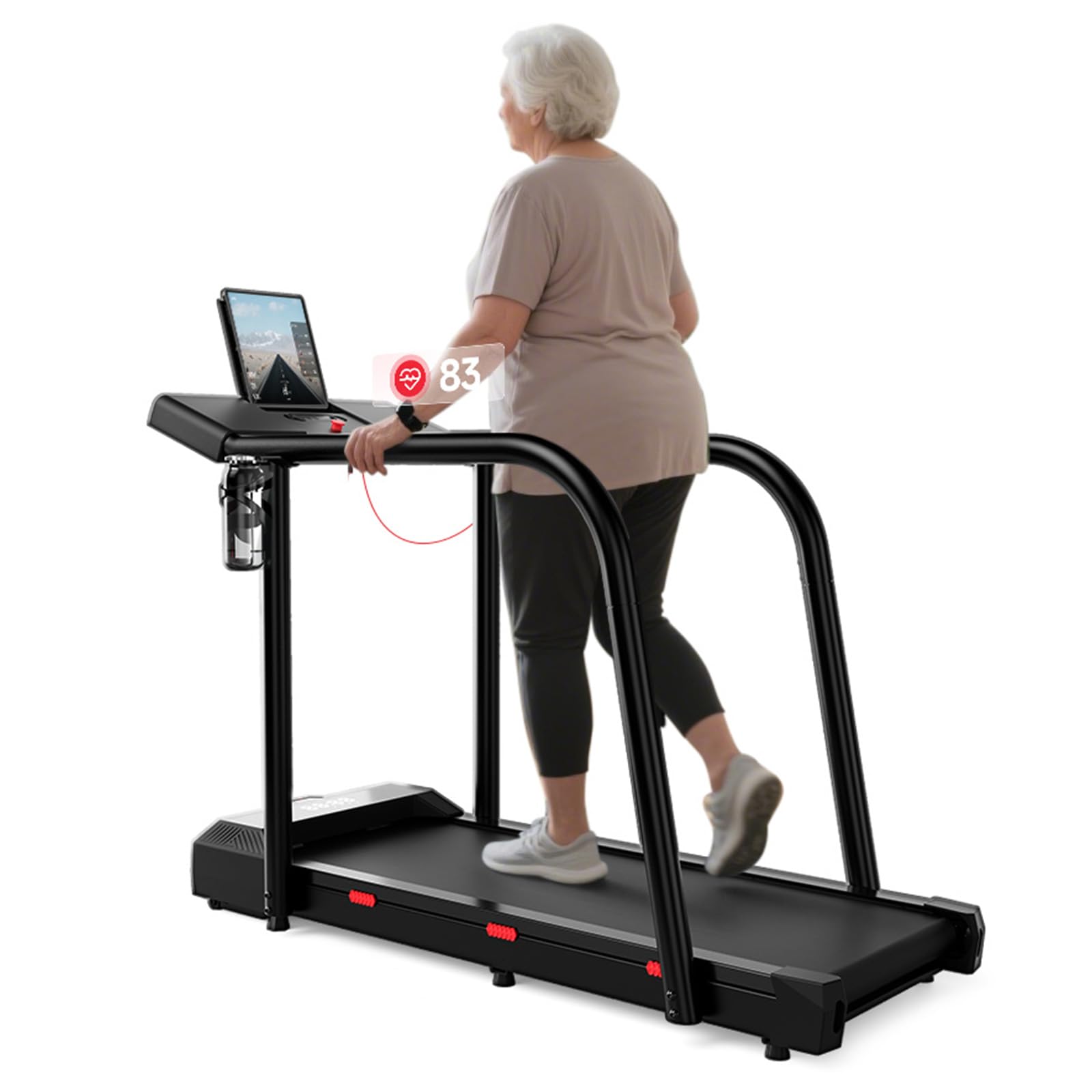
Yesoul Senior Treadmill

Small rooms

Our Score 9.2/10
Check Price

Worth Noting

  • Slowest setting is 0.6 mph, not 0.3
  • Non-folding frame claims floor space
Item Weight
48 lb
Emergency Stop
One-tap button
Starting Speed
0.6 mph
Weight Capacity
300 lb
Read the full review

The best idea on the Yesoul is the stop button. One tap brakes the belt, and that immediacy is worth more here than any program list — the moment someone loses their rhythm, the machine responds to a hand rather than to a hunt for a key. Extended handrails run alongside the deck for support, and the belt is a six-layer sandwich over six shock absorbers, the sort of construction your knees register rather than your eyes.

Everything else is aimed at a tight room. At 48 pounds it's the lightest machine here by a wide margin, which matters if it has to be wheeled out of the way; the frame doesn't fold, so it does need a permanent footprint. A remote handles speed and mode so you aren't bending to the console mid-walk, the LED screen covers time, calories, steps, speed and distance, and the 3.8 mph ceiling keeps it firmly a walking machine.

The number to think hard about is 0.6 mph. That's the slowest the belt will go, roughly double the 0.3 mph floor on the Redliro and Exerpeutic, and for someone rebuilding confidence after a fall it can feel brisk on the first step of the day. A steady walker who wants a compact, quiet machine with an obvious off switch gets a lot for the money; a very cautious one should start the comparison at the Redliro.

Bottom line: For a small room and a walker who wants the belt stopped without thinking about it, the Yesoul's one-tap emergency button and 48-pound frame earn the pick.

#2

Exerpeutic Senior Fitness Treadmill

Exerpeutic Senior Fitness Treadmill

Dedicated senior walking

Our Score 8.8/10
Check Price

Worth Noting

  • Top speed of 4 mph rules out jogging
  • Seventy-one pounds, so pick the spot first
Warranty
2 years limited
Handrails
Full-length, foam-padded
Speed Range
0.3 to 4 mph
Weight Capacity
400 lb
Read the full review

A treadmill bought for a parent in their eighties has to answer one question before any other: can you get on and off it while holding something solid? Exerpeutic's answer is a low platform and rails running the full length of the deck on both sides, foam-padded where your hands actually land. We stepped on and off repeatedly with our hands on the rails rather than the console, and there was always something at hip height beside us and behind us, which is the part most walking treadmills miss.

The spec we like most looks like a limitation on paper. Top speed is 4 mph, which rules out jogging and is exactly right for this job: with the belt capped there, you aren't one mis-tap away from a pace your legs didn't choose. Speed starts at 0.3 mph and moves in tenths of a mile per hour, so you can nudge from 1.5 to 1.6 when the jump to 2.0 feels like a trot. The 400-pound weight limit is the highest in this group, six deck cushions sit under the belt, and the two-year limited warranty is twice the cover the Redliro and Yesoul state.

At 71 pounds with a 53 by 26 inch footprint, it wants a corner of its own, so decide where it lives before the carton arrives. What you get for the space is a machine that is always set up, with a backlit display for time, distance, calories and pulse, and two pockets for glasses and a phone. Nothing about a daily walk needs to be negotiated with a folding mechanism first.

Bottom line: We send anyone shopping purely for safe walking to the Exerpeutic: full-length padded rails, a 400-pound limit, and a top speed that never outruns your feet.

#3

Redliro Walking Treadmill JK06F

Redliro Walking Treadmill JK06F

Shared household use

Our Score 8.8/10
Check Price

Worth Noting

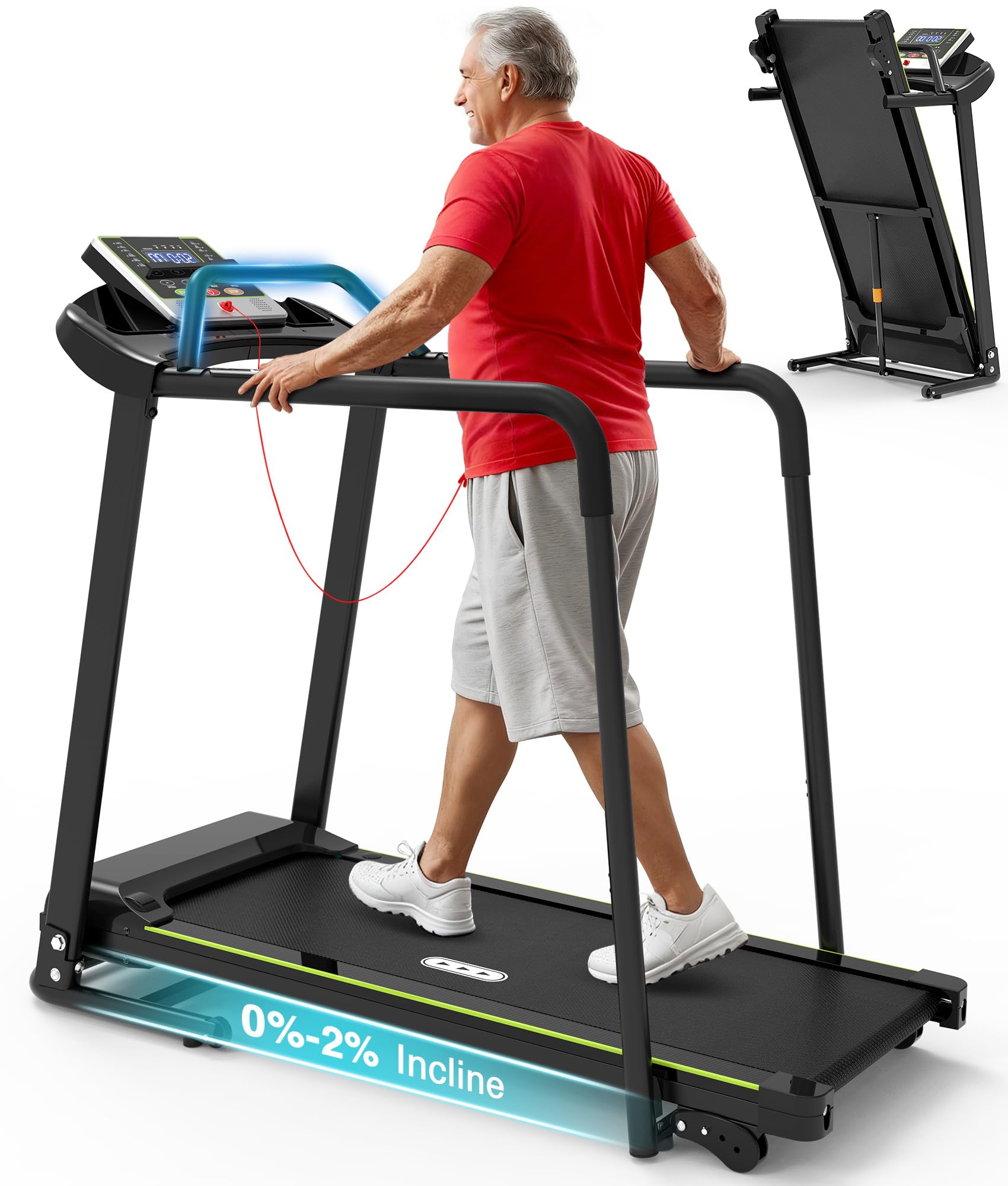
  • Incline is fixed at 2%, not adjustable
  • 41-inch belt is short for a long stride
Handrails
Extended side rails plus front bar
Folded Size
51.2 x 27.4 x 9.4 inches
Starting Speed
0.3 mph
Weight Capacity
300 lb
Read the full review

Two people, one machine — that's the case the Redliro JK06F makes better than anything else in this group. It starts at 0.3 mph, slow enough that stepping onto the moving belt isn't a lunge, and it climbs to 5.5 mph, so a spouse or an adult child can get a real walk out of it. Twelve programs and automatic belt lubrication round out a package aimed at a household rather than a single user.

The rails run the length of the deck with an extra bar across the front, which gives you a second thing to grab while stepping up. Underneath, the belt is 41 inches long and 16 inches wide, and that's where the compromise sits: a long stride runs out of deck at the back. If the primary walker is tall or takes a big step, this is the figure to think about before the price or the programs.

Folding is where it gets awkward. The listed folded depth is just over nine inches, but the handrails aren't quick-release, so folding means taking the rails off and finding somewhere to put them; in practice ours stayed up between walks, which is fine if the room can spare the floor. The trade against the Exerpeutic comes down to the ceiling and the frame: 5.5 mph and programs make the JK06F the shareable one, while the 300-pound limit, the fixed 2% incline and the one-year warranty sit below what the top pick offers.

Bottom line: The Redliro is our pick when two people share one machine: it drops to 0.3 mph for a cautious walker and still reaches 5.5 mph for everyone else.

#4

FYC Walking Treadmill Q23L

FYC Walking Treadmill Q23L

App-guided walking

Our Score 8.6/10
Check Price

Worth Noting

  • Compact belt limits a long stride
Handrails
Full-length extended rails
Top Speed
7.5 mph
Item Weight
66 lb
Weight Capacity
300 lb
Read the full review

Stride is the first thing to check on the FYC, because the belt is the tightest part of the package. A compact walking surface is fine for a short, careful step and less fine for anyone with a long one, where the back edge arrives sooner than you expect. That single question decides more about daily comfort here than any feature on the console.

Above the belt, this is the most entertaining machine in the group. Full-length rails give you something to hold at a low platform, the backlit display uses large legible type, and the Fit Show app drops forest and beach scenes in front of you with virtual tracks to follow — a feature none of the other picks here offer. Eight spring absorbers sit under a six-layer belt for knee care, and at 66 pounds on casters it's easier to reposition than the Redliro or Exerpeutic.

The 7.5 mph top speed is far past a walking brief and only earns its place if someone younger shares the machine. We still start most buyers at the longer deck: the app is a pleasant companion, but the surface under your feet decides whether the walk feels roomy or cramped, and that's the thing you can't adjust later.

Bottom line: The FYC suits a walker who wants scenery and app sessions on a compact machine, provided a long stride isn't part of the picture.

How We Tested the Best Treadmills for Walking

We started with roughly 40 treadmills sold by mainstream retailers and cut anything without handrails running the length of the deck, a safety key, or a starting speed slow enough to step on without a lunge. Decks shorter than 50 inches were dropped, and so were machines that needed a subscription to use the belt. What remained we sorted by price and footprint, then brought in seven.

Assembly came first, because it's where these machines are usually abandoned. With one person and a stopwatch, we unpacked, built, and took a first step on each one, noting how many stages required a second set of hands and where the deck had to be lifted alone. Then we measured footprint, folded depth, and step-up height with a tape measure and pushed each machine through a standard doorway to see whether it would clear a hallway or a spare-room door.

For the next nine months we walked on them at 1.5 to 3 mph — in slippers, in sneakers, holding the rails and with our hands swinging free. We noted whether the belt started smoothly or hiccuped, how much the front of the deck dipped when we stepped on, and whether the console could be read without reading glasses. We changed the incline mid-walk to see if it lurched, pulled the safety key at 3 mph to time how fast the belt stopped, and stood in the next room to listen for motor whine through a floor.

Every few weeks we checked belt tension, listened for new rattles, and wiped down the consoles. Value got the last word: we tracked which features we paid for and never touched, because most walkers won't, and a machine that does the basics well for less beats one with a screen nobody opens.

How to Choose Treadmills for Walking Seniors

Handrails that reach the back of the deck

A rail that stops at the console is a rail you can only hold while standing still. What you want is a bar at hip height running to the back edge of the deck, so your hands find it before the first step and after the last one. The Exerpeutic is the clearest example here, with foam padding the whole way down both sides.

The test takes ten seconds once the machine is assembled: stand behind it and put your hands where they'd naturally fall. If the rail ends a foot ahead of you, you'll be reaching forward every time you get on. And hold the rails for balance rather than to carry your weight — leaning on them shortens your stride and takes work out of the walk.

The slowest speed matters more than the fastest

Two numbers tell you more than any other pair: the minimum speed and the size of each step up. A 0.3 mph floor is close to a shuffle, while 0.6 mph is nearly double that and can feel brisk on the first step for someone rebuilding confidence after surgery or a fall.

Increments decide the rest. Tenths of a mile per hour let you settle between 1.5 and 2.0, where half-mile jumps leave you choosing between too slow and too fast. Check both figures before ordering — a high top speed is a family-sharing feature, not a senior one.

Step-up height, deck length, and floor space

A low deck is easier to mount, and long rails only help if you can reach them from a standing start. Deck length is the figure buyers skip and later regret: a 41-inch belt suits a short, careful step and runs out on a long one, and if two people share the machine, size it for the taller walker.

Measure the floor as well. The picks here run about 49 to 53 inches deep and 22 to 26 inches wide, and you need standing room behind the deck to get on. A folding frame still has to go somewhere, and on rail-equipped models the rails often come off first.

Capacity, controls, and what happens after the sale

Weight limits in this group run from 300 to 400 pounds, and the margin is worth paying for: a heavier frame with a higher limit feels steadier when you put a hand on the rail and lean. That's a large part of why the 400-pound Exerpeutic is our default.

Controls should be readable without glasses and reachable without bending, which makes a remote or a large stop button worth more than a dozen workout programs. Warranties are a year on the Redliro and Yesoul and two years on the Exerpeutic, and worth reading before anything is assembled.

Frequently Asked Questions

Final Verdict

The Exerpeutic is the treadmill we point most buyers to, and the reason is narrow and specific: it's built around the two things an older walker actually needs, a rail you can hold from the back of the deck and a belt that moves in tenths of a mile per hour. The 400-pound frame and two-year warranty make it the better long-term buy.

Choose the Redliro JK06F when a second, faster user will share the machine and 5.5 mph matters. Choose the Yesoul when the room is small and the budget is tight, as long as a 0.6 mph starting speed suits the walker.