Cardio Machines

Best Mini Exercise Bikes for Seniors of 2026

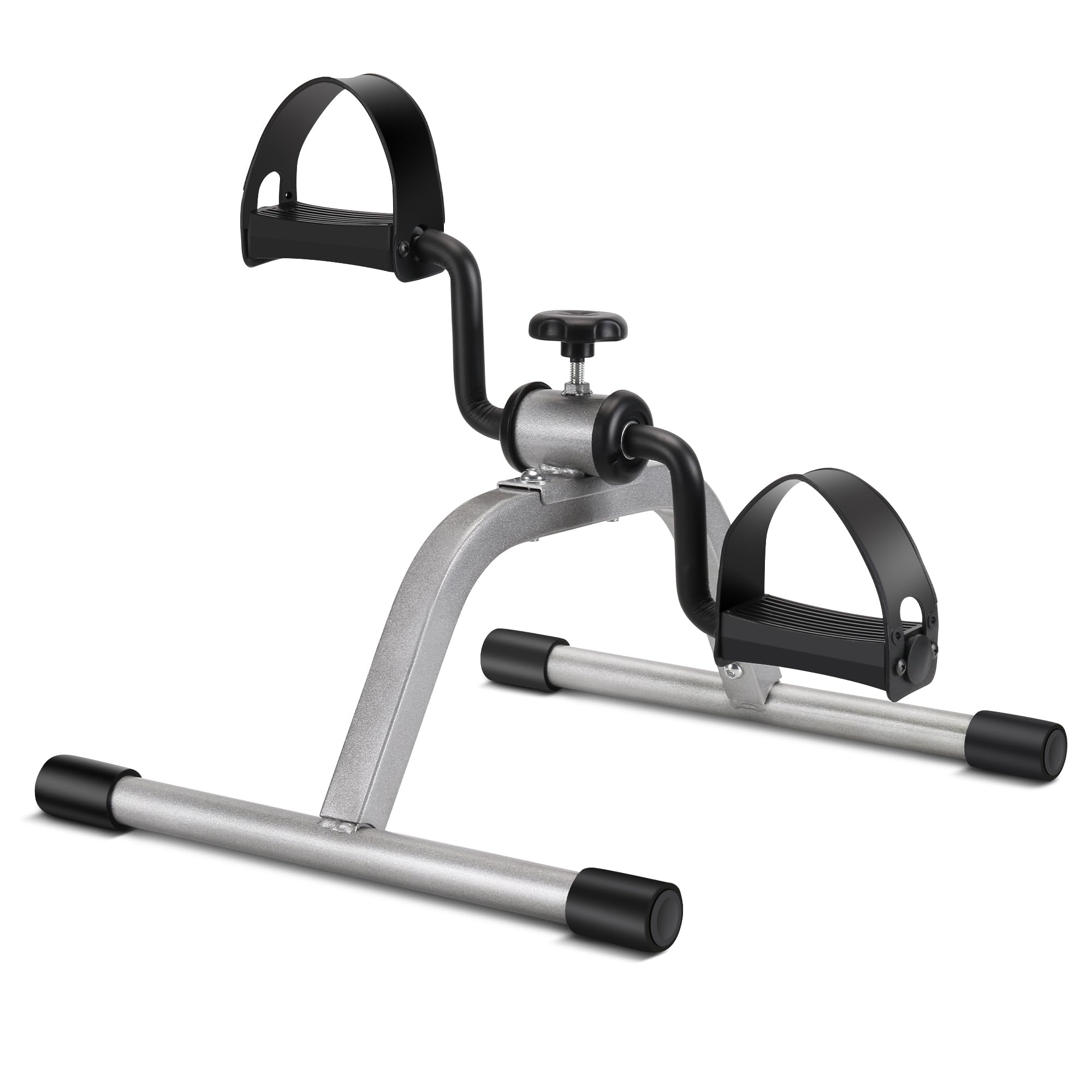
The first thing my father asked when I set a mini exercise bike in front of his armchair was whether it would slide out from under him. That's the real test. These little machines promise low-impact movement without a trip to the gym, but only if the frame stays planted, the pedals turn smoothly, and the tension dial cooperates with older hands. A good one keeps circulation moving while you watch the evening news; a bad one wobbles, squeaks, or ends up in the closet. The right pick disappears into your routine.

We've spent eight months pedaling 10 models in living rooms, beside kitchen tables, and under home desks. Assembly, weight, and quiet operation separated the contenders as much as workout quality did. A bike that's hard to move or noisy enough to interrupt conversation won't get used, no matter how well it's built. The picks below are the ones that felt stable, smooth, and genuinely worth the space.

#1

MOMODA Pedal Exerciser

Top Pick
MOMODA Pedal Exerciser

Arm workouts

Our Score 8.4/10
Check Price

Worth Noting

  • 176-pound user limit
Weight
9.5 lb
Display
LCD
Resistance
Adjustable knob
Max User Weight
176 lb
Read the full review

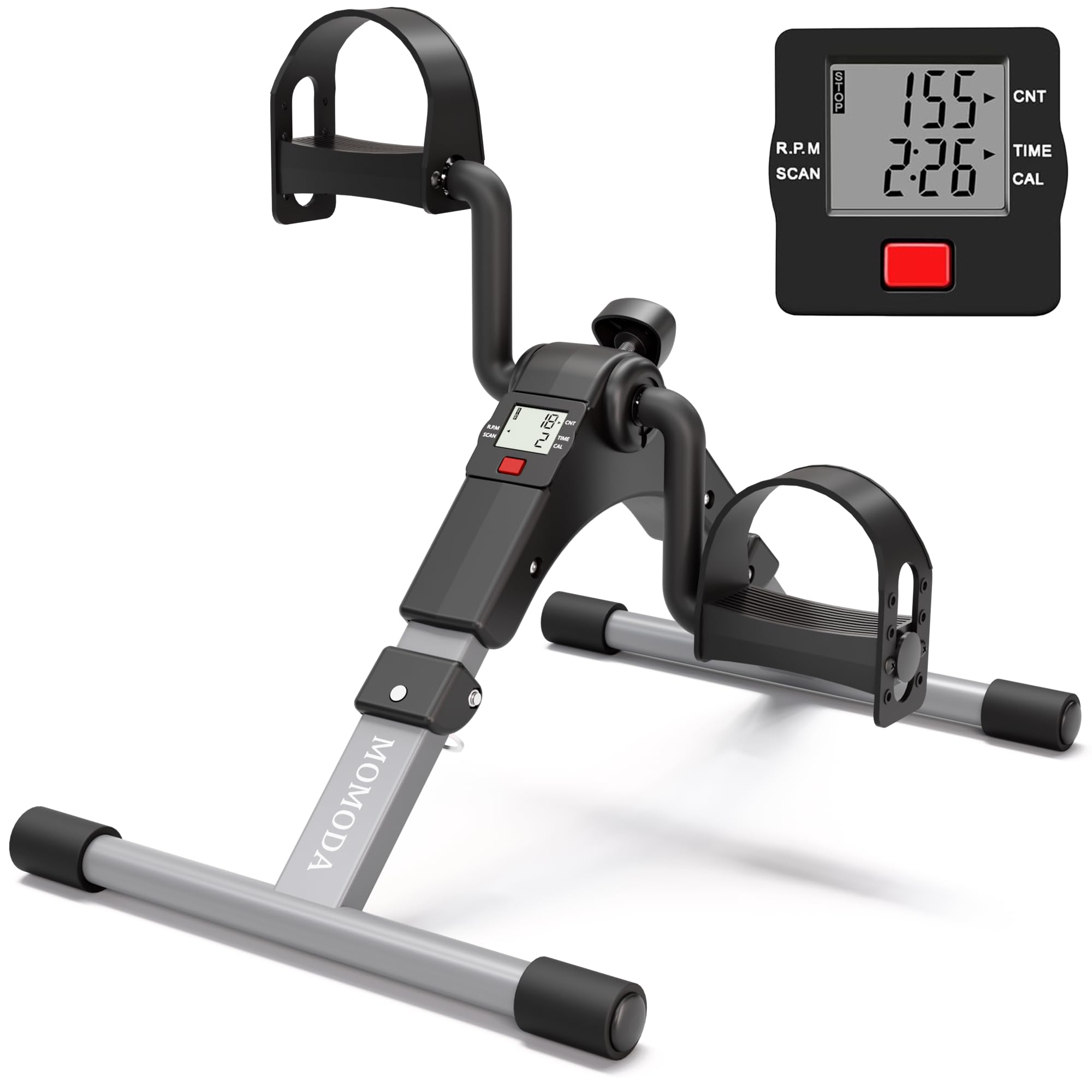
For arm work at a table, the MOMODA is the one we reach for first. At 9.5 pounds it lifts from the floor to a coffee table without much fuss, and the compact frame leaves room for your knees underneath. The four-step assembly is genuinely quick, and the LCD gives you time, count, distance, and calories in a size you can read without leaning in.

The 176-pound maximum user weight is the catch. That is well below the Sunny's 300-pound limit, so a heavier senior should look there instead. The tension knob can also start firmer than expected; back it off before the first session rather than forcing it. Once set, the motion is light and the pedals turn smoothly enough for short arm sets.

We keep it in the arm-work slot because it is easier to live with on a table than the bigger bikes. It is not the most planted unit on the floor, and the plastic body does not feel as substantial as the Sunny. For a smaller user who wants a compact arm-and-leg bike without a large footprint, those are fair trade-offs.

Bottom line: Our pick for arm work at a table, as long as the 176-pound user limit is not a constraint.
#2

RYGEO Foldable Mini Bike

RYGEO Foldable Mini Bike

Tiny spaces

Our Score 8.4/10
Check Price

Worth Noting

  • Resistance range is narrow
Assembly
Fully assembled
Warranty
2 years
Footprint
18 x 15 x 14 inches
Resistance
Adjustable knob
Read the full review

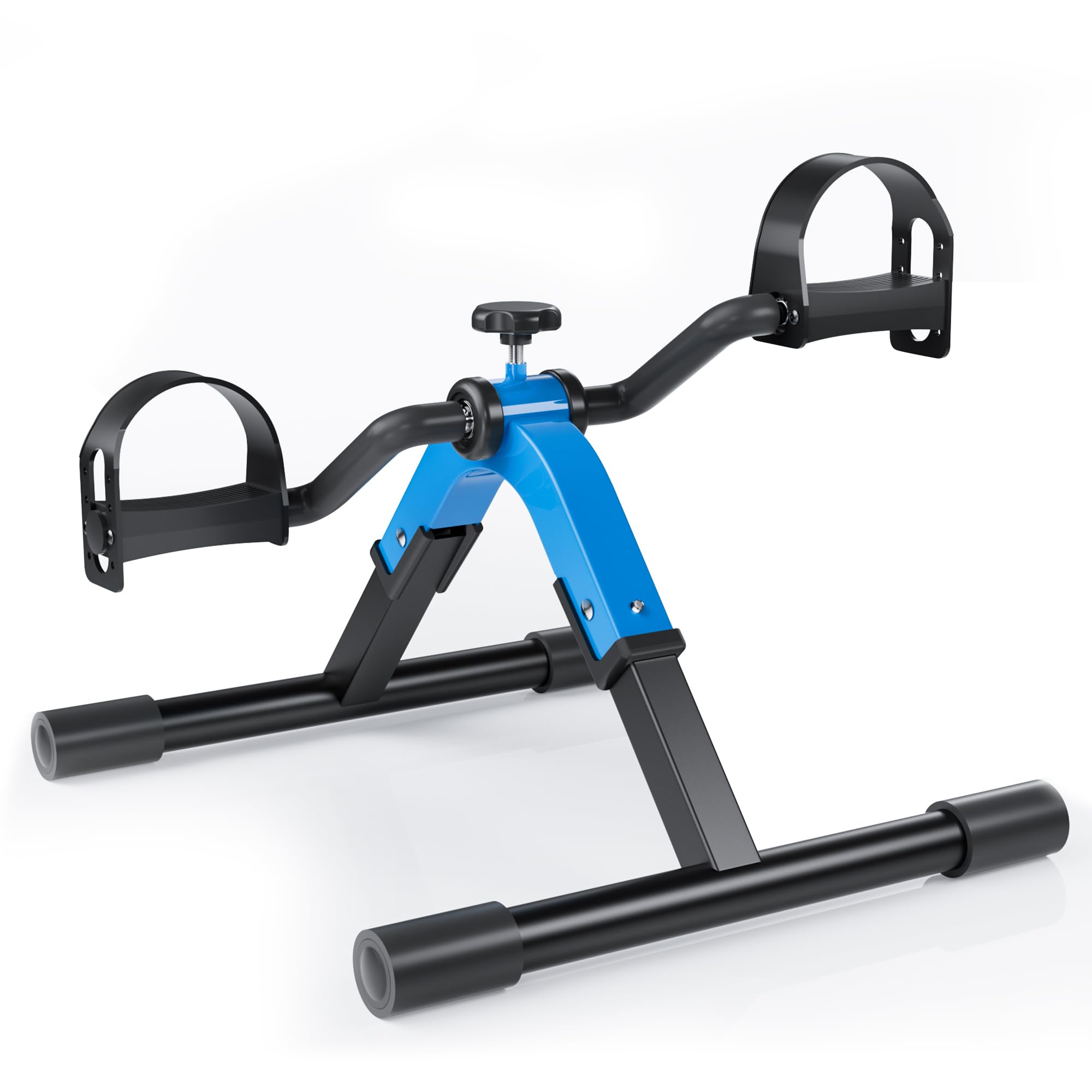
The RYGEO arrives fully assembled, which is the kind of small mercy that makes a difference when the bike is a gift for a parent or grandparent. It also folds, so it can live beside a sofa or in a closet instead of taking over a corner. We appreciate the two-year warranty at this end of the market; it is the longest coverage among our picks.

The trade is a frame that flexes a little at the hinge. On low-pile carpet it feels settled enough for easy pedaling, but on bare hardwood it can shift. That is the compromise for a bike that stores flat, and it is easier to accept if the bike will stay in one spot rather than move from room to room.

What sells it is the lack of fuss: it arrives ready to pedal, folds away, and asks nothing more than a turn of the resistance knob. That makes it a good fit for a senior who wants short daily movement without an assembly project or a lot of setup. It is the pick we hand to someone who wants the simplest possible start.

Bottom line: We choose the RYGEO when setup and storage matter more than a display or a refined resistance dial.

#3

MEMEDA Folding Pedal Exerciser

MEMEDA Folding Pedal Exerciser

Tracked sessions

Our Score 8.4/10
Check Price

Worth Noting

  • Tension knob can feel vague
Weight
5.7 lb
Display
LCD
Folding
Quick-fold
Resistance Levels
5
Read the full review

The LCD is what separates the MEMEDA from the bare folding bikes here. It shows time, count, RPM, calories, and a scan mode, so you can see whether you are actually settling into a rhythm instead of just guessing. At 5.7 pounds, it is light enough to move from the den to the bedroom, and the quick-fold hinge makes it easy to tuck away.

We recommend it for short, low-resistance sessions rather than for someone who wants a planted feel. On smooth hard floors the non-skid feet may not hold; a rug or mat makes a noticeable difference. The display is still the reason to choose it over a simpler folding bike, because it gives enough feedback without a complicated setup.

For a senior who likes a little information but does not want a full-size machine, this is a useful little bike. Keep the resistance light and the sessions short, and the folding convenience outweighs the less refined feel. It is not the bike for hard pedaling or a permanent spot on a polished floor.

Bottom line: We like the MEMEDA for short, light sessions where a readable display and a folding frame matter more than a planted feel.

#4

RYGEO Ultra-Light Mini Bike

RYGEO Ultra-Light Mini Bike

Room-to-room use

Our Score 8.4/10
Check Price

Worth Noting

  • One-year warranty
Power
Self-powered
Weight
4.2 lb
Warranty
1 year
Resistance Levels
5
Read the full review

At 4.2 pounds, the ultra-light RYGEO is the one we pick when the bike has to be lifted, not just slid. It is the easiest of these to carry from a bedroom to a living room, and the five resistance levels give a beginner a clear place to start. The self-powered design means no batteries and no display to fuss with.

That low weight is also why it can skate on smooth floors. A mat is not optional here, especially if the bike will be used on hardwood or tile. The resistance changes are simple rather than refined, and the light frame does not feel as substantial as the Sunny. Those are the costs of making a bike this easy to move.

For gentle range-of-motion work, the light resistance is well matched to short sessions in a favorite chair. It is not the bike for someone who wants a weighted, planted feel; the Sunny is better there. But if the deciding issue is whether you can lift it at all, this RYGEO earns its place.

Bottom line: This is our carry-anywhere pick for a senior who needs the lightest possible bike, provided a mat goes under it.

#5

Sunny Smart Mini Cycle

Sunny Smart Mini Cycle

Seated daily use

Our Score 8.2/10
Check Price

Worth Noting

  • Weighs 11.7 pounds
  • Parts coverage lasts only 180 days
Weight
11.7 lb
Display
LCD
Resistance
Stepless knob
Max User Weight
300 lb
Read the full review

The first thing we noticed about the Sunny is how little noise it makes: the mesh belt drive disappears under a television or a conversation, which matters when the bike lives in a living room. The low, wide frame gives you room to set your feet without feeling perched, and the carry handle is well placed for moving it out of the way. The LCD is simple but readable, and the 2-in-1 layout switches from floor pedaling to tabletop arm work without extra parts.

That combination is why it earns our top spot. The stepless knob lets you begin with almost no resistance and add a little at a time, which suits a senior who wants gentle range-of-motion work rather than a workout. The 300-pound maximum is the largest among our picks, and the low frame gives you a solid platform. We also like that the pedals turn smoothly enough to use while reading or watching TV, without the machine demanding your attention.

It is not perfect on every floor. On smooth hardwood, the Sunny can creep when you push the pace; a thin mat or a low-pile rug keeps it in place. It is also a lift for some people, even with the handle. Neither issue changes the recommendation for a bike that will stay beside a favorite chair, but they are the reasons the lighter picks here exist.

Bottom line: For most seniors, this is the mini bike we point to first: quiet, easy to start light, and built with the widest weight margin here.

How We Tested the Best Mini Exercise Bikes for Seniors

We started by gathering more than 40 mini bikes sold for home use, then narrowed the list by reading specs and customer reviews for clues about stability, footprint, and how the tension system works. We filtered out models with vague weight limits, flimsy pedal straps, or resistance dials that reviewers described as slippery or hard to turn. The final 10 ranged from simple under-desk units to sturdier models with wider bases.

For eight months, we pedaled each bike in the places it would actually live: beside a living-room armchair during morning news, under a kitchen table while paying bills, and next to a home-office desk during phone calls. We tested on hardwood and low-pile carpet, noting whether the base crept forward or rocked when we pushed the tension to its highest setting. We timed assembly out of the box, counted how many steps required tools, and then carried each bike from closet to living room to judge weight and mobility.

We pedaled at the easiest and hardest resistance, paying attention to whether the stroke felt smooth or jerky and whether the tension changed gradually or jumped. We turned the dial with bare hands and then with mild arthritis gloves to see if adjustability held up for older users. Quiet operation got checked during TV shows and phone calls—any whir, click, or squeak counted. We also watched for build quality over time: loose bolts, wobbly pedals, stretched straps. Workout quality came down to whether 15 minutes felt useful rather than fidgety, and functionality meant the bike fit under a desk without banging knees. Finally, we weighed what each unit included against its price to judge value.

How to Choose a Mini Exercise Bike for Seniors

Put Stability Before Features

A mini bike is only useful if it stays where you put it. Light frames are easier to lift, but they are also the ones that skate across hardwood when you pick up the pace. If the bike will live beside one chair, choose a heavier unit and a non-slip mat; the Sunny's 11.7-pound frame is the planted end of this group. If it has to move between rooms, a 4.2-pound model like the RYGEO is easier to carry, but it needs a rug or mat underneath.

Your chair matters as much as the bike. A firm dining chair or desk chair gives you a stable base; a soft recliner lets your hips rock and changes the angle of your knees. Set the bike far enough away that your knee can make a full turn without locking or pinching.

Look for Resistance That Starts Light

A senior does not need a wide range of hard resistance; they need the first turn to be easy and the changes to be gradual. A stepless knob, like the one on the Sunny, lets you add resistance in small increments. A five-level knob can work too, but check that the lowest setting is genuinely light rather than merely the least difficult.

Turn the resistance all the way down before the first session, then add a quarter turn at a time. If the pedals feel stiff at the start, the bike is not set up for gentle range-of-motion work. The MEMEDA's five levels are enough for short sessions, though its knob is less precise than the Sunny's.

Decide Whether It Folds or Stays Put

Folding bikes are for storage and travel; fixed bikes are for a permanent spot. The RYGEO folding model arrives assembled and folds to roughly 18 by 15 by 14 inches, which is useful in a small apartment or for tucking beside a sofa. The MEMEDA also quick-folds and adds a display. Neither feels as solid as a fixed frame, and a folding hinge can flex under hard pedaling.

If the bike will not move, skip the hinge and put the money into a steadier frame. If it will travel in an RV or move between rooms, choose the lightest model you can lift safely and accept that it may need a mat. The 4.2-pound RYGEO is the easiest carry here, but it is also the easiest to push out of place.

Plan for Arms, Feet, and the Chair

Arm use changes the setup. You want the bike on a firm table or a wide armrest, with the pedals close enough that you do not have to lean forward. The MOMODA's 9.5-pound frame is easy to lift onto a coffee table, and its LCD is readable from a seated position. For leg use, adjust the pedal straps before the first session; a loose strap lets your foot slip and makes the whole motion feel unstable.

Keep the bike close enough that your knee stays bent at the bottom of the stroke, but not so close that your hip rocks. If you have limited ankle movement, have someone set the straps for you and check that your heel stays in the pedal.

Check the Parts and Warranty

Pedals, straps, and resistance knobs are the parts that wear first. Look for a warranty that covers the frame and, ideally, the pedals for more than a few months. The Sunny covers its frame for a year but its other parts for only 180 days; the folding RYGEO carries a two-year warranty. The MEMEDA's coverage is less clearly stated, so keep the listing and ask the seller before you rely on it.

A simple machine with replaceable pedals is easier to live with than a feature-heavy one with no support. Before ordering, confirm that the seller lists replacement straps or pedals, and check the maximum user weight against the person who will use it.

Frequently Asked Questions

Final Verdict

Our default for a senior who wants one bike beside a favorite chair is the Sunny Health & Fitness Smart Mini Cycle. It is the quietest and most adjustable of these, and its 300-pound limit gives more households room to share it.

If you need to lift the bike daily, the 4.2-pound RYGEO is the practical alternative; for arm work on a table, the MOMODA makes more sense.